8 AI Voice Agent Companies Startups Should Shortlist
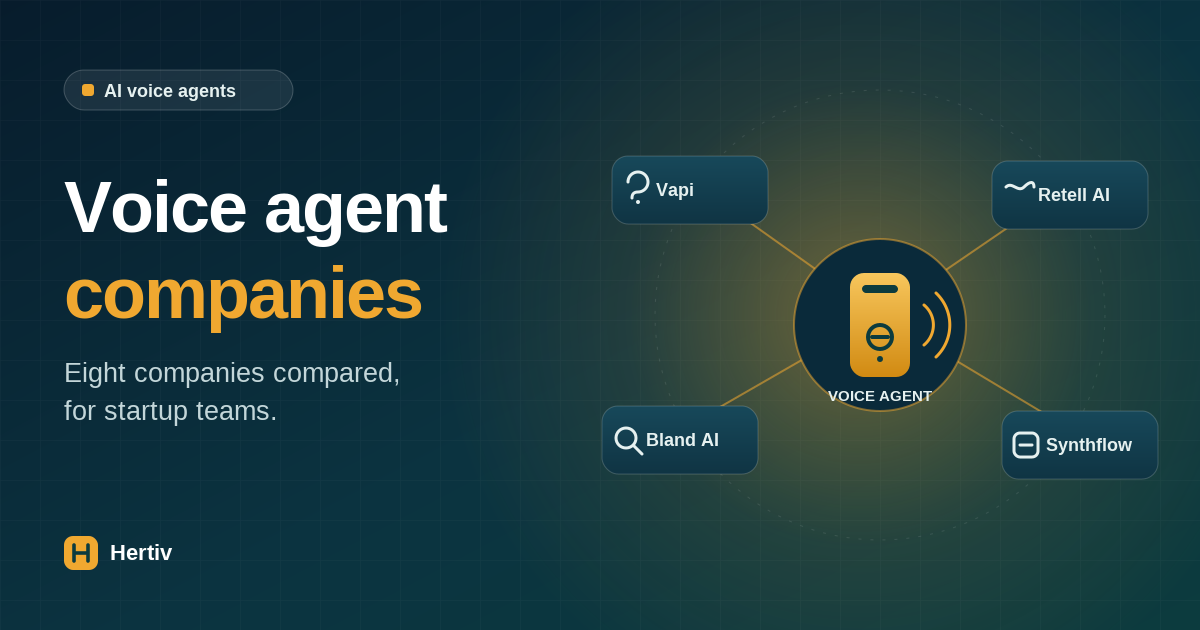
Eight AI voice agent companies compared for startups: platforms you build on, voice models, and full-service firms, with how to pick the right fit.
On this page
Short answer
The AI voice agent companies startups should shortlist are Vapi, Retell AI, Bland AI, Synthflow, ElevenLabs, LiveKit, Cognigy and Kore.ai. Platforms suit teams that want to build and run their own agents, while full-service firms suit teams that want an agent delivered for them, and the right pick depends on your call volume, your integrations and how much control you need.
Which AI voice agent companies should startups shortlist?
Start with what the agent must do: answer support calls, book appointments, qualify sales leads or chase payments. That job decides whether you need a platform you build on, a voice model you plug in, or a team that delivers the whole agent for you.
Use this comparison to shortlist two or three companies, then run a small pilot on real calls before you commit to a contract.
| Company | What it is | Best for | How you use it |
|---|---|---|---|
| Vapi | Voice agent platform | Fast custom agents | Build with API and dashboard |
| Retell AI | Voice agent platform | Natural-sounding calls | Build with API and dashboard |
| Bland AI | Voice agent platform | High-volume outbound calls | Build with API and dashboard |
| Synthflow | Voice agent platform | No-code agent setup | Build with visual builder |
| ElevenLabs | Voice model provider | Realistic voices | Use its voice models in your agent |
| LiveKit | Real-time infrastructure | Custom voice pipelines | Build with open source tools |
| Cognigy | Conversational AI platform | Enterprise contact centres | Platform plus services |
| Kore.ai | Conversational AI platform | Large support operations | Platform plus services |
Pricing varies with call minutes, the voice model and the support level, so check the vendor site for current pricing. The rest of this article compares what each company handles, not what it charges.
Voice agent platforms: Vapi and Retell AI
1. Vapi: best for building a custom voice agent fast
Vapi is a developer platform for voice agents. You define the agent's prompt, connect a phone number, plug in your tools and data, and Vapi handles the speech recognition, the language model, the voice output and the call itself. It suits startups that want a working agent in days rather than months.
Its strength is speed and control: you can change the prompt, swap models and add function calls without rebuilding the phone layer. Its weakness is that you still own the agent design, the prompts and the testing, so a team with no one to run that work will move slowly.
- Pros: fast to build, flexible model choice, good tooling for developers
- Cons: you own prompt design and testing, costs grow with call volume
2. Retell AI: best for natural-sounding voice calls
Retell AI is a voice agent platform with a focus on low latency and natural conversation. It handles interruption, backchanneling and turn-taking, so callers can speak over the agent and the agent can respond without long pauses. It suits support and booking calls where the caller should feel they are talking to a person, not a menu.
Its strength is conversation quality: calls feel smoother than a basic text-to-speech setup, and the platform includes call analytics and transcripts. Its weakness is that it is still a platform, so your team must design the conversation flows and connect the agent to your systems.
- Pros: natural turn-taking, low latency, call analytics included
- Cons: you design the flows, pricing scales with minutes
Outbound and no-code: Bland AI and Synthflow
3. Bland AI: best for high-volume outbound calls
Bland AI is a voice agent platform built for outbound calling at scale: appointment reminders, payment follow-ups, lead qualification and surveys. You can send thousands of calls at once, and the agent adapts its script to what the person says instead of reading a fixed message.
Its strength is volume and control: campaigns, call lists and outcomes are managed in one place, and every call is recorded and transcribed. Its weakness is fit. It is built for outbound work, so inbound support teams may find other platforms a better match.
- Pros: built for outbound volume, campaign management, full transcripts
- Cons: less suited to inbound support, outbound rules vary by country
4. Synthflow: best for no-code voice agent setup
Synthflow is a voice agent platform with a visual builder, so a non-technical team can set up an agent, connect it to a calendar or CRM, and start taking calls without writing code. It suits small teams that want an agent for bookings, FAQs or lead capture and do not have developers to spare.
Its strength is ease of use: the builder covers the common cases, and integrations with calendars, CRMs and phone numbers are ready made. Its weakness is depth. Unusual workflows, custom logic and heavy integrations are harder to build than on a developer platform.
- Pros: no-code setup, ready integrations, fast to launch
- Cons: less flexible for custom logic, fewer model choices
For the background on building one yourself, how to build an AI voice agent walks through the parts an agent needs.
Voice models and infrastructure: ElevenLabs and LiveKit
5. ElevenLabs: best for realistic voices in your agent
ElevenLabs is a voice AI company known for realistic text-to-speech voices and voice cloning. Startups use its voices inside their own agents, or use its conversational AI product to build a voice agent around them. It suits teams where the voice itself matters, such as coaching, media or customer-facing products.
Its strength is voice quality: the voices sound natural across many languages, and you can clone a brand voice with consent. Its weakness is that it is a voice layer, not a full agent platform, so you still need the call handling, the language model and the integrations around it.
- Pros: very natural voices, many languages, voice cloning with consent
- Cons: a voice layer, not a full agent, needs other parts around it
6. LiveKit: best for building a custom voice pipeline
LiveKit is open source real-time infrastructure for voice and video. Teams use it to build their own voice agent pipelines, choosing their own speech recognition, language model and voice output, with full control over latency, data handling and hosting. It suits engineering teams that want to own the whole stack.
Its strength is control: you choose every component, you can self-host, and there is no per-minute platform fee on top of your own costs. Its weakness is effort. Building and running a pipeline takes real engineering time, so it suits teams with developers to spare.
- Pros: full control, open source, self-hosting possible
- Cons: needs engineering effort, you run the infrastructure
Enterprise platforms: Cognigy and Kore.ai
7. Cognigy: best for enterprise contact centres
Cognigy is a conversational AI platform used by large contact centres. It supports voice and chat agents, works across many languages, and connects to the CRM, ticketing and telephony systems that big support teams already run. It suits startups that sell into large enterprises or run a large support operation themselves.
Its strength is breadth: one platform covers voice and chat, many channels and many integrations, with the governance and reporting that large teams need. Its weakness is weight. It is built for large deployments, so a small startup may find the setup heavier than a focused voice platform.
- Pros: voice and chat in one platform, strong integrations, enterprise reporting
- Cons: heavier setup, pricing suits larger teams
8. Kore.ai: best for large support operations
Kore.ai is a conversational AI platform for voice and digital agents, used by banks, retailers and healthcare providers. It offers pre-built agents for common support tasks, tools for building custom ones, and the security and compliance features that regulated teams ask for.
Its strength is the library of ready agents and the enterprise controls around them. Its weakness is the same as Cognigy's: it is built for scale, so a small team may pay for more platform than it needs.
- Pros: ready-made agents, strong compliance features, many integrations
- Cons: enterprise pricing, longer setup than a focused platform
If you are weighing the use cases first, AI voice agent use cases shows where voice agents already work for real teams.
How to choose an AI voice agent company
Choose by running a pilot on real calls, not by comparing feature lists. A pilot shows you how the agent sounds, how often it hands off, and how much work your team must do to keep it running.
- Define one job for the pilot. Pick a single task, such as booking appointments or answering delivery questions, and measure how well the agent handles it.
- Test with real callers. Record a set of real calls, run them through the agent, and count how many it resolves without a human.
- Check the handoff. Confirm the agent can pass a call to a human with the transcript and context, and that the human sees what happened.
- Price the real volume. Work out your monthly call minutes, then ask each vendor for a quote on that volume, including the voice model and support.
- Ask about data handling. Confirm where call recordings and transcripts are stored, how long they are kept, and whether they are used to train models.
Keep the shortlist short. Two companies tested on the same pilot will tell you more than eight compared on paper. AI voice agent development services can help you plan the pilot before you pick a vendor.
Common mistakes when choosing a voice agent company
The most common mistakes are picking on voice quality alone, skipping the handoff test, and underestimating the work of keeping prompts and flows up to date.
- Choosing on voice quality alone. A natural voice does not fix a bad conversation flow. Test whether the agent resolves the caller's problem, not only how it sounds.
- Skipping the handoff test. Every agent fails some calls. If the handoff to a human is clumsy, those failures become angry customers.
- No owner for the prompts. Prompts and flows drift as your product changes. Assign someone to review call transcripts weekly and update the agent.
- Ignoring outbound rules. Outbound calling is regulated in many countries. Check the rules for consent, calling hours and opt-outs before launching a campaign.
- Underestimating call volume costs. Per-minute pricing looks small until you multiply it by thousands of calls. Model the cost at your real volume, not at pilot volume.
- Testing only happy paths. Callers interrupt, change their minds and ask odd questions. Test those cases, not only the smooth ones.
Key takeaways
- Vapi, Retell AI, Bland AI and Synthflow are platforms you build on; Cognigy and Kore.ai suit large operations
- ElevenLabs supplies the voice; LiveKit supplies the real-time plumbing for a custom pipeline
- Pick by running a pilot on real calls, not by comparing feature lists
- Test the handoff to a human as carefully as the agent itself
- Model the cost at your real call volume, not at pilot volume
- Assign someone to review transcripts weekly and keep the prompts up to date
Frequently asked questions
What is the best AI voice agent company for a startup?
There is no single best choice. Vapi and Retell AI suit teams that want to build fast, Synthflow suits no-code teams, Bland AI suits outbound volume, and Cognigy and Kore.ai suit large support operations. Pick the model that fits your call volume and your team.
How much does an AI voice agent cost?
Cost depends on call minutes, the voice model, the platform and the support level. Per-minute pricing looks small at pilot volume and grows with real traffic. Ask each vendor for a quote on your expected monthly minutes and check the vendor site for current pricing.
Can an AI voice agent handle inbound support calls?
Yes, for well-defined tasks such as bookings, order status and FAQs. The agent should hand off to a human when the caller is upset, the request is complex, or the agent is unsure. Test the handoff before launch.
What is the difference between Vapi and ElevenLabs?
Vapi is a voice agent platform that handles the call, the models and the tools around the agent. ElevenLabs is a voice model provider whose realistic voices can be used inside an agent built on another platform. Many teams use both together.
Do voice agents work in languages other than English?
Most platforms support several languages, and some support dozens. Voice quality and understanding vary by language, so test the agent in each language you plan to serve before you promise it to customers.
How long does it take to launch an AI voice agent?
A simple agent on a no-code platform can take days. A custom agent with CRM integrations, testing and a handoff flow usually takes several weeks. The pilot and the testing take longer than the build itself.


