AI in Auditing: Where It Helps, and Where to Start
AI in auditing helps with document review, anomaly detection and continuous monitoring. It flags the exceptions; auditors still make the judgement calls.
On this page
Short answer
AI in auditing is the use of machine learning to review documents, test transactions and flag anomalies across a full data set instead of a small sample. It helps auditors find the exceptions worth investigating, but it does not replace professional judgement: a person still decides what a finding means and what to do about it.
What is AI in auditing?
AI in auditing is the use of machine learning to help auditors review documents, test transactions and spot anomalies. Instead of sampling a few dozen transactions and hoping the sample is representative, an audit team can run checks across the full population and focus human time on the exceptions.
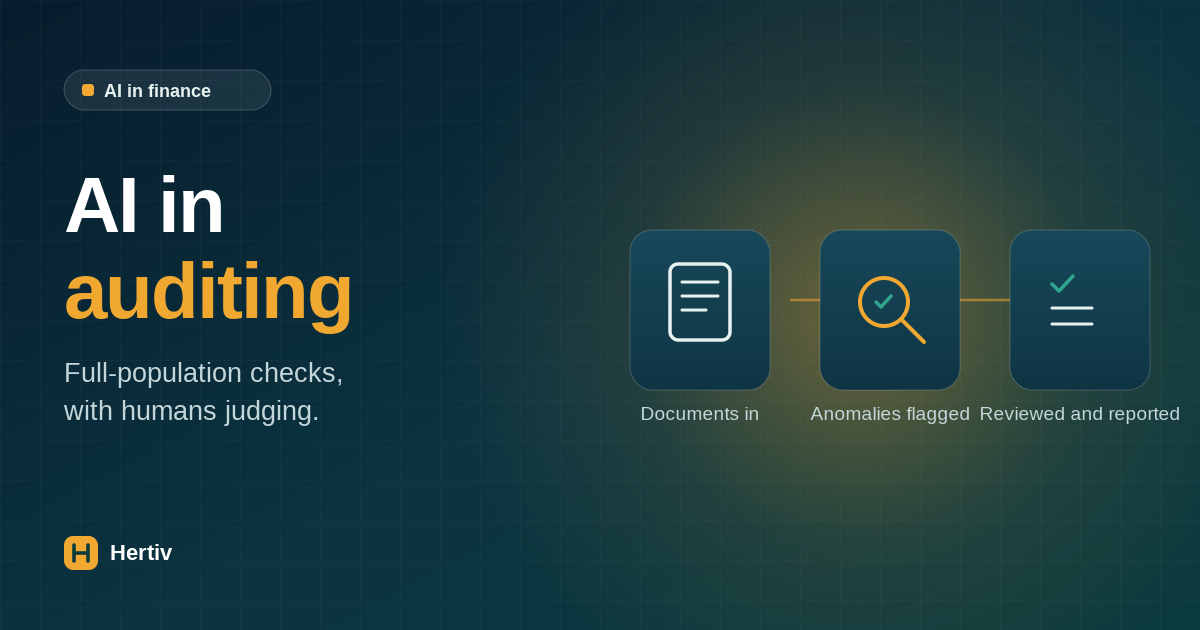
The core idea is simple: auditors spend most of their time on routine checking, and machines are good at routine checking. AI reads contracts and invoices, compares them with ledger entries, and flags the items that do not match. The auditor then investigates the flagged items, which is the work that actually needs judgement.
This is not a new kind of audit. The standards, the evidence requirements and the need for a defensible trail are unchanged. What changes is the coverage: full-population testing instead of sampling, and continuous monitoring instead of a once-a-year review. Teams in finance are usually the first to adopt it, and AI agents for finance covers the related workflow patterns.
Where AI helps most in an audit
AI helps most where the work is repetitive, the data is digital, and the volume is too large for people to check by hand.
| Use case | What AI does | What the auditor still does |
|---|---|---|
| Document review | Extracts terms and amounts from contracts and invoices | Judges whether the terms are correct |
| Transaction testing | Tests every transaction against rules and patterns | Investigates the exceptions |
| Anomaly detection | Flags unusual amounts, dates and vendors | Decides whether the anomaly is fraud or error |
| Journal entry review | Scores entries by risk and finds odd combinations | Reviews the high-risk entries in depth |
| Continuous monitoring | Watches controls and flags breaks as they happen | Acts on the alerts and reports the findings |
| Risk assessment | Surfaces patterns across years of data | Sets the audit plan and scope |
Document review is usually the first use case, because it has a clear return: hours of reading removed, with a validation step that catches most errors. Anomaly detection follows once the data is clean enough to trust the flags.
How does AI anomaly detection work in an audit?
AI anomaly detection in an audit works by learning what normal looks like in your transaction data and flagging the items that do not fit, so auditors spend their time on the exceptions.
The usual approach combines rules and models. Rules catch the known problems: duplicate invoices, round-number amounts, postings on weekends, vendors with no address. Models catch the subtler ones: a vendor whose amounts drift upward over months, a user who posts entries outside their normal pattern, or a combination of fields that rarely appears together.
Every flag needs a reason. A flag that says only "unusual" is useless, because the auditor cannot defend it or act on it. Good systems explain the flag in plain terms, such as "this vendor received 14 payments this month against a usual 3", and link to the underlying records. That explanation is part of the audit evidence.
False alarms are expected. The goal is not zero false alarms, which would mean the system is too timid to catch anything, but a flag rate the team can actually review. If the team cannot review the flags, the system is not helping.
Example: an audit team tests a full year of transactions
Example (hypothetical): an audit team reviews a year of accounts payable data containing 2,400 transactions. In the past, the team sampled 120 transactions and checked them by hand. This year, an AI tool tests all 2,400.
The tool flags 180 transactions as exceptions. Reviewers check each one and confirm 132 as real exceptions, such as duplicate payments and invoices posted to the wrong period, and 48 as false alarms, such as legitimate rush orders that looked unusual. The numbers add up: 132 plus 48 equals 180.
The team also finds that 3 of the 132 exceptions were in the old sample of 120, which means the old approach would have caught 3 and missed 129. The remaining 2,220 transactions pass the automated checks, and the team documents the checks, the flags and the review decisions as audit evidence.
The point is not that the tool found more problems. It is that the team can now say what was tested, what was flagged and what was decided, for every transaction rather than for a sample.
What are the common mistakes?
The most common mistakes in AI auditing are trusting the tool without checking it, feeding it dirty data, and treating a flag as a finding.
- Trusting flags without review. A flag is a lead, not a conclusion. Every flag needs a human decision and a recorded reason.
- Dirty data. If vendor names are spelled five ways and dates are inconsistent, the model flags noise instead of problems.
- No validation set. Without a labelled set of known good and bad cases, you cannot tell whether the system is improving.
- Black-box flags. If the tool cannot explain a flag, the auditor cannot defend it, and the finding is weak.
- Skipping the evidence trail. Audit work needs a record of what was tested, what was flagged and what was decided. A tool that does not log those is not audit-ready.
- Over-automation. Automating the judgement, not just the checking, removes the professional scepticism the audit depends on.
How to start using AI in auditing
You start using AI in auditing by picking one repeatable check, proving it on a labelled sample, and building the evidence trail around it before expanding.
- Pick one check. Choose a high-volume, rule-based task such as duplicate invoice detection or journal entry review.
- Clean the data. Standardise vendor names, dates and codes before the tool sees them, or the flags will be noise.
- Build a validation set. Label a set of known good and bad cases, and measure the tool against it.
- Run it alongside the old process. Compare the AI flags with the sample results for one cycle before relying on them.
- Document everything. Record what was tested, what was flagged, what was decided and why, so the work stands up to review.
Governance matters from the start: who owns the model, how it is validated, and how its decisions are recorded. AI governance covers that structure.
Document AI is the usual starting point for the document review use case.
What AI cannot do in an audit
AI cannot make judgement calls, and an audit is mostly judgement calls. It cannot decide whether a transaction is fraudulent or merely odd, whether a control failure is material, or whether management's explanation is credible.
It also cannot audit what it cannot see. Verbal agreements, off-system arrangements and management intent leave no digital trace, and no model can test them. The auditor's interviews, observation and scepticism remain the core of the work.
Finally, AI cannot take responsibility. When a finding is challenged, a person must be able to explain the evidence and defend the conclusion. A model output on its own is not a defence. The right mental model is an assistant that extends coverage, not a replacement for the auditor.
Key takeaways
- AI in auditing extends coverage from a sample to the full population
- Document review and anomaly detection are the first use cases to prove
- Every flag needs a human decision and a recorded reason
- Dirty data produces noise, not insight: clean it before the tool sees it
- AI cannot make judgement calls or take responsibility for a finding
Frequently asked questions
Is AI in auditing just sampling with a computer?
No. Sampling tests a small subset and infers the rest, while AI tools can test the full population of transactions and flag every exception. The auditor still investigates the flags, but the coverage is complete rather than inferred from a sample.
Can AI detect fraud in an audit?
AI can flag patterns that look like fraud, such as duplicate payments, unusual vendors or odd posting times, but it cannot prove fraud. A flag is a lead that an auditor investigates; the conclusion that fraud occurred is a human judgement based on evidence.
What data does AI auditing need?
It needs clean, complete transaction data with standardised fields for vendors, dates and amounts, plus access to the documents behind the transactions. Dirty data is the most common reason AI audit tools produce noise instead of useful flags.
Do auditors need to learn to code to use AI tools?
No. Most AI audit tools are built for auditors, with rules and dashboards rather than code. What auditors do need is enough understanding of how the tool works to explain a flag and defend a finding.
How do we validate an AI audit tool before relying on it?
Build a labelled validation set of known good and bad cases and measure the tool against it. Run it alongside the existing process for one cycle and compare the results, then document what was tested and what was decided.
Will AI replace auditors?
No. AI replaces routine checking, which is the part of the job that scales least well. The judgement, interviews, scepticism and responsibility that define an audit remain human work, and audit standards still require a person to own the opinion.


