AI Trends Interview Questions and How to Answer Them
Interviewers ask about AI trends to test judgement, not memory. These six questions come up often, with what a strong answer covers and what to avoid.
On this page
Short answer
AI trends interview questions test how you think about change: where AI is heading, what matters most, how you handle risk and what you would build first. A strong answer names a real workflow, a cost and a check, not just a model.
Which AI trends interview questions come up most?
Interviewers ask about AI trends to test judgement, not memory. They want to hear how you think about change, not a list of model names. Six questions come up again and again, and each one has a strong answer and a weak one.
The table below maps each question to what it really tests. Read it first, then work through the detail for each question before your interview.
| Question | What it tests | Strong answer shows |
|---|---|---|
| Where is AI heading? | Judgement | Production over pilots |
| What matters more: model or data? | Priorities | Data and evaluation |
| How do you handle AI risk? | Responsibility | Checks and human review |
| Which trend is overhyped? | Scepticism | Evidence over headlines |
| How will AI change this job? | Self-awareness | Workflows, not job titles |
| What would you build first? | Practical sense | One workflow, measured |
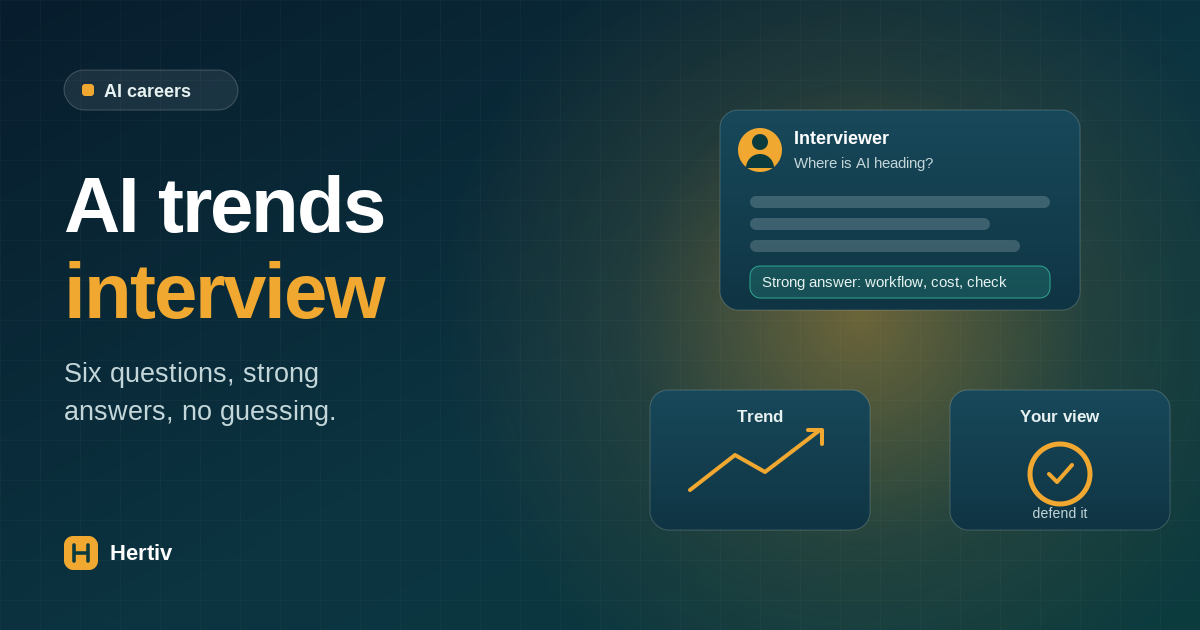
A good answer always names a real workflow, a cost and a check. A weak answer names a model and stops there. Keep that rule in mind for every question below.
1. Where is AI heading in the next two years: best for testing judgement
This question tests whether you follow the field or just repeat headlines. A strong answer picks one or two shifts you can defend, such as the move from pilots to production systems, and the shift from training costs to running costs.
Explain why the shift matters for the team you are joining. A production system needs monitoring, evaluation and a human review step, which is a different job from running a demo. Name the work that changes, not just the model that changes.
Strong answer:
- Names a shift: pilots to production, or training costs to running costs
- Links it to work: says what changes for the team day to day
- Admits uncertainty: says what could prove the view wrong
Avoid:
- Naming a model: a model name is not a trend
- Predicting a date: nobody knows when a change lands
- Repeating a headline: headlines are not evidence
2. What matters more, the model or the data: best for testing priorities
This question tests whether you know where AI projects actually fail. The honest answer is that the model is rarely the hard part. The data, the evaluation set and the review process decide whether a system works in practice.
Explain it with an example. A support assistant fails when its knowledge base is out of date, not when the model is a version behind. A retrieval system fails when the documents are messy, not when the embedding model changes. The model is one part of a system that includes data, prompts, checks and people.
Strong answer:
- Picks data: says the data and evaluation decide the result
- Gives an example: a stale knowledge base or messy documents
- Names the system: data, prompts, checks and review together
Avoid:
- Saying the model: a better model does not fix bad data
- Being absolute: the model matters, but it is not the bottleneck
- No example: an answer without an example sounds borrowed
3. How do you handle AI risk: best for testing responsibility
This question tests whether you take responsibility for what a system does. A strong answer names the risks that fit the job, such as wrong answers reaching customers, private data leaking, or a model behaving differently on some groups of people.
Then name the checks: human review on high-stakes outputs, logging so decisions can be traced, limits on what the system can do on its own, and a fixed set of test cases run regularly. The point is not to list every risk, but to show you think in terms of checks, not hopes.
Strong answer:
- Names real risks: wrong answers, data leaks, uneven behaviour
- Names checks: review, logging, limits and regular tests
- Owns the outcome: says who is responsible when it goes wrong
Avoid:
- Saying it is safe: no system is safe by default
- Only naming bias: risk is wider than one issue
- No owner: a check without an owner does not happen
4. Which AI trend is overhyped: best for testing scepticism
This question tests whether you can push back on a trend without sounding dismissive. Pick one trend you think is ahead of the evidence, and explain why with a specific reason, such as a missing evaluation, a cost nobody mentions, or a demo that does not survive real data.
The key is to be fair. Say what the trend gets right, then say where the evidence is thin. An answer that calls everything hype shows no judgement. An answer that accepts everything shows no judgement either. The middle is the point.
Strong answer:
- Picks one trend: a specific claim, not the whole field
- Gives a reason: missing evaluation, hidden cost or weak demo
- Stays fair: says what the trend gets right first
Avoid:
- Calling everything hype: it sounds like a reflex, not a view
- No reason: an opinion without evidence is just a mood
- Attacking a vendor: judge the claim, not the company
5. How will AI change this job: best for testing self-awareness
This question tests whether you have thought about your own work, not just the field. A strong answer names one workflow in the job and says which parts AI can take, which parts it cannot, and what the person should spend the freed time on.
For example, a support role might lose routine ticket triage to an agent but keep the angry customers and the edge cases. A research role might lose the first draft of a summary but keep the judgement about which sources to trust. The pattern is the same: the routine steps move, the decisions stay.
Strong answer:
- Names a workflow: one real task in this job
- Splits the work: routine steps move, decisions stay
- Says what fills the gap: harder cases, review, relationships
Avoid:
- Saying nothing changes: it signals you have not thought about it
- Saying the job disappears: it signals you have not thought about it either
- Talking only about tools: the job is the workflow, not the tool
6. What would you build first: best for testing practical sense
This question tests whether you can turn a trend into a plan. A strong answer picks one workflow, says what the first version does, how you would measure it, and what would make you stop or change direction.
Keep the scope small. One workflow, one model, a fixed set of test cases and a decision date. A candidate who proposes a platform on day one has not built one before. A candidate who proposes a pilot with a measurement has.
Strong answer:
- One workflow: a single task with a clear result
- A measure: how you know it worked, in numbers you can check
- A stop rule: what would make you change or stop
Avoid:
- A platform: a platform is a second project, not a first one
- No measure: without a measure, nobody can tell if it worked
- No stop rule: a plan with no exit is a commitment, not a test
How to prepare for AI trends questions in four steps
You prepare for AI trends questions by forming a view, testing it on real work, and practising the answer out loud. Four steps cover it.
- Pick two shifts you believe in. Choose trends you can defend with a reason, such as production over pilots or running costs over training costs, and write one paragraph on each.
- Attach each shift to a workflow. For each trend, name a real task it changes and what the change looks like day to day. A trend without a workflow is a headline.
- Prepare one sceptical answer. Pick a trend you think is overhyped and write down the evidence gap in two sentences, fairly.
- Practise out loud. Answer each question in under a minute, then check whether you named a workflow, a cost and a check. If not, try again.
Preparation is not memorising model names. It is having a view, a reason and an example ready, so you can answer a question you have not seen before. For a sense of what teams actually buy, global AI market trends shows how buyers weigh the same shifts.
What are the common mistakes?
The most common mistakes in AI trends interviews are answering with model names, repeating headlines, and having no view of your own.
- Answering with model names. A model name is not a trend, and naming the newest one shows you follow releases, not the field.
- Repeating headlines. If your answer could come from a news summary, it tells the interviewer nothing about your judgement.
- No view of your own. Saying every trend is exciting is not a view. Pick a position and defend it.
- Ignoring cost and checks. An answer that never mentions running costs, evaluation or human review misses the parts that decide real projects.
- Talking only about the future. The interviewer wants to know what you would do now, not what might happen in ten years.
The fix for all five is the same: name a workflow, a cost and a check, and give a reason. That is what separates a candidate who has done the work from one who has only read about it.
Key takeaways
- A trend answer needs a workflow, a cost and a check
- Data and evaluation matter more than the newest model
- Risk answers should name checks, not hopes
- Fair scepticism beats both hype and dismissal
- One small pilot beats a platform as a first answer
Frequently asked questions
Should I memorise the latest AI models for an interview?
No. Interviewers care more about judgement than model names. Know one or two shifts you can defend, such as the move from pilots to production, and link each shift to a real workflow and its costs.
What is the best answer to where AI is heading?
Pick one or two shifts you can defend, explain why they matter for the team, and say what could prove you wrong. An answer that names a workflow and a cost is stronger than one that lists model names.
How do I answer which AI trend is overhyped?
Pick one specific claim, say what it gets right, then give a concrete reason the evidence is thin, such as a missing evaluation or a hidden cost. Fairness matters as much as the criticism.
What if I do not know the answer to a trends question?
Say so, then reason from what you do know. Name a workflow you understand, work through what would change and what you would check. Interviewers value clear thinking over a guessed answer.
How long should my answers be?
Under a minute for most questions. State your view, give one reason and one example, then stop. A short answer with a workflow, a cost and a check beats a long answer that wanders.
Do interviewers expect me to know the company's AI plans?
It helps to know what the company sells and who uses it, so you can link your answers to their work. You do not need inside knowledge, but an answer that fits their product shows you prepared.


