AI Strategy for Business: How to Build One That Works
An AI strategy says which business problems AI will solve, what data and skills that needs, and how to measure success. Here is how to build one in five steps.
On this page
Short answer
An AI strategy is a plan that says which business problems artificial intelligence will solve, what data and skills that work needs, and how the business will judge success. Without one, AI projects start in many places at once, cost money, and never reach the people who would benefit. This guide shows how to build a strategy that stays tied to real work.
What is an AI strategy for business?
An AI strategy for business is a written plan that links AI work to business goals. It names the problems worth solving, the data those problems need, the team that will do the work, and the measures that show whether the work paid off. It is a business document first and a technology document second.
A good strategy is short enough to read in one sitting and specific enough to guide a decision. It does not list every tool on the market. It says which three or four problems come first, why they matter, and what happens if the pilot fails.
| Part of the strategy | What it answers |
|---|---|
| Goals | Which business results will AI improve? |
| Use cases | Which problems come first, and why? |
| Data | What data do those problems need, and is it ready? |
| People | Who builds, checks and owns each use case? |
| Rules | What must never happen, and who checks? |
| Measures | How will we know the work paid off? |
The rest of this guide works through each part, with a five-step plan and a worked example. The aim is a strategy your team can follow, not a document that sits in a drawer.
Where should AI help first?
AI helps first where work is repetitive, rule-based and data-rich. Sorting support tickets, pulling numbers from invoices, drafting first replies and spotting odd patterns in orders are all good candidates, because the task repeats often and the result is easy to check.
Start with a problem that has a clear owner and a clear measure. A support lead who can say "this task takes my team 30 hours a week" gives you a baseline to beat. A vague goal such as "use AI everywhere" gives you nothing to measure, so the project drifts.
Avoid starting with the hardest problem. A task that needs deep judgement, sensitive data or a perfect answer is a poor first pilot, because an early failure can end the whole programme. Pick a problem where a partial win still helps and a mistake is cheap to fix.
How to build an AI strategy in five steps
Building an AI strategy takes weeks, not months, if you keep it focused. The five steps below turn a broad ambition into a plan with owners and dates.
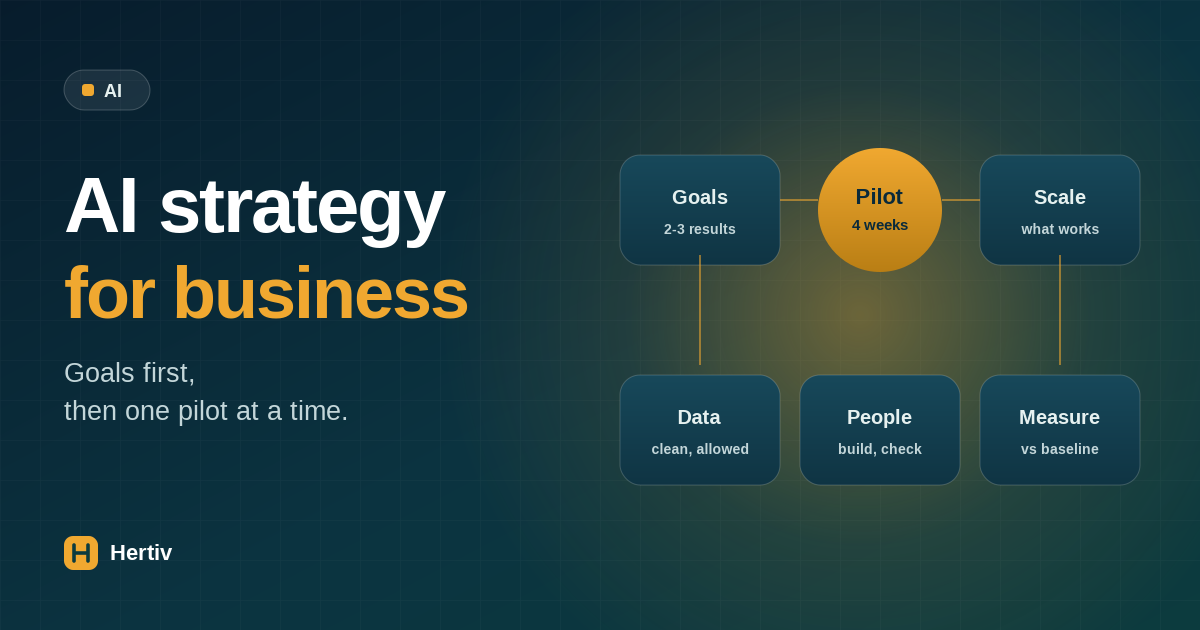
- Pick the goals: choose two or three business results AI should improve, such as faster replies or fewer errors, and write them down with numbers.
- List the use cases: gather ideas from the teams that do the work, score each one on value and effort, and keep the top three.
- Check the data: for each use case, confirm the data exists, is clean enough to use, and may legally be used for that purpose.
- Run one pilot: build the smallest version that answers a real question, put it in front of real users, and measure the result for four weeks.
- Decide what scales: keep the pilots that beat their baseline, stop the ones that did not, and write the lessons into the next round.
Write the strategy down as you go, in plain language, and share it with the teams affected. A strategy that only the leadership team has read is not a strategy yet.
What data and skills does an AI strategy need?
Data is the part most strategies underestimate. An AI tool is only as good as the records it reads, so a strategy must say where the data lives, who keeps it clean, and what is missing. A pilot that needs five years of labelled tickets will fail if the tickets were never labelled.
Skills matter as much as data. A business needs someone who understands the problem, someone who can build and test the tool, and someone who checks the answers. Small businesses often buy the building skill and keep the checking skill in-house, which is a sensible split.
Budget for both. A strategy that funds the model but not the data cleaning or the review time will stall at the first real test. Put data work and checking time in the budget from the start, and the pilot will move faster.
Example (hypothetical): a retailer pilot
Example (hypothetical): a retailer with 12 shops wants faster answers to delivery questions. The support team handles 300 such questions a day, and each takes about 6 minutes to answer, which is 300 times 6, or 1,800 minutes, equal to 30 hours a day across the team.
The pilot drafts answers from the order system and a staff member checks each one before sending. Checking takes about 1 minute per question, so the team spends 300 minutes, or 5 hours a day, instead of 30. That saves about 25 hours a day, which the team uses for the harder questions that still need a person.
The strategy set a clear rule for the pilot: if the share of correct drafts falls below 8 in 10, the pilot stops and the team reviews the data. That rule gave the staff confidence to try the tool, because they knew a bad result would end it.
What can go wrong with an AI strategy?
An AI strategy can go wrong in a few predictable ways. The first is buying tools before naming problems, which leaves the business with software nobody asked for and no measure of success. The second is letting one department run AI alone, so the rest of the business never learns what works.
The third is ignoring the rules. AI that reads customer data must follow the privacy rules of your market, and answers that affect money or health need a human check. A strategy should name these limits plainly, so no team has to guess where the line is.
The fourth is expecting a pilot to pay for itself at once. A first pilot is a test, and its value is the learning it produces, not the money it saves in week one. Judge the pilot on what it teaches, and judge the programme on the pilots that follow.
Common mistakes in an AI strategy
The most common mistake is writing a strategy that is really a shopping list. A list of tools is not a strategy, because it says nothing about which problems come first or how success is measured. Start with the problems, and let the tools follow.
Another mistake is setting no baseline. If you do not know how long a task takes today, you cannot show that AI made it faster, and the business case falls apart. Measure the current work before the pilot starts.
A third mistake is forgetting the people who do the work. Staff who were never asked about the pilot will resist it, however good the tool is. Invite them to name the problems, test the drafts and set the rules, and the strategy will have allies instead of critics.
Key takeaways
- An AI strategy links AI work to business goals, data and measures.
- Start with repetitive, data-rich work that has a clear owner and baseline.
- Run one pilot, measure it for four weeks, then scale what beats its baseline.
- Budget for data cleaning and human checking, not just for the model.
Frequently asked questions
What is the first step in an AI strategy?
The first step is to pick two or three business results AI should improve, such as faster replies or fewer errors, and write them down with numbers. Everything else in the strategy, from use cases to data, follows from those goals.
How long does an AI strategy take to build?
A focused strategy takes a few weeks. Picking goals and use cases takes days, checking the data takes longer, and the first pilot usually runs for about four weeks. A strategy that takes six months to write is too long to be useful.
Does a small business need an AI strategy?
Yes, and a small business needs a shorter one. Pick one problem, one pilot and one measure, and write the plan on a single page. The discipline of choosing matters more than the size of the document.
How do you measure an AI pilot?
Measure the pilot against the baseline you recorded before it started, such as hours spent or errors made per week. Add a quality check, such as the share of answers a reviewer accepts, so speed is not the only measure.
What data does an AI project need?
It needs data that covers the problem, is clean enough to trust, and may legally be used for that purpose. Most pilots fail on data, not on the model, so check the data before you build anything.
Who should own the AI strategy?
A senior leader should own it, with input from the teams that do the work and the people who manage data and risk. Ownership by one department alone usually means the rest of the business never adopts what is built.


