How AI Is Used in Banking and Fintech
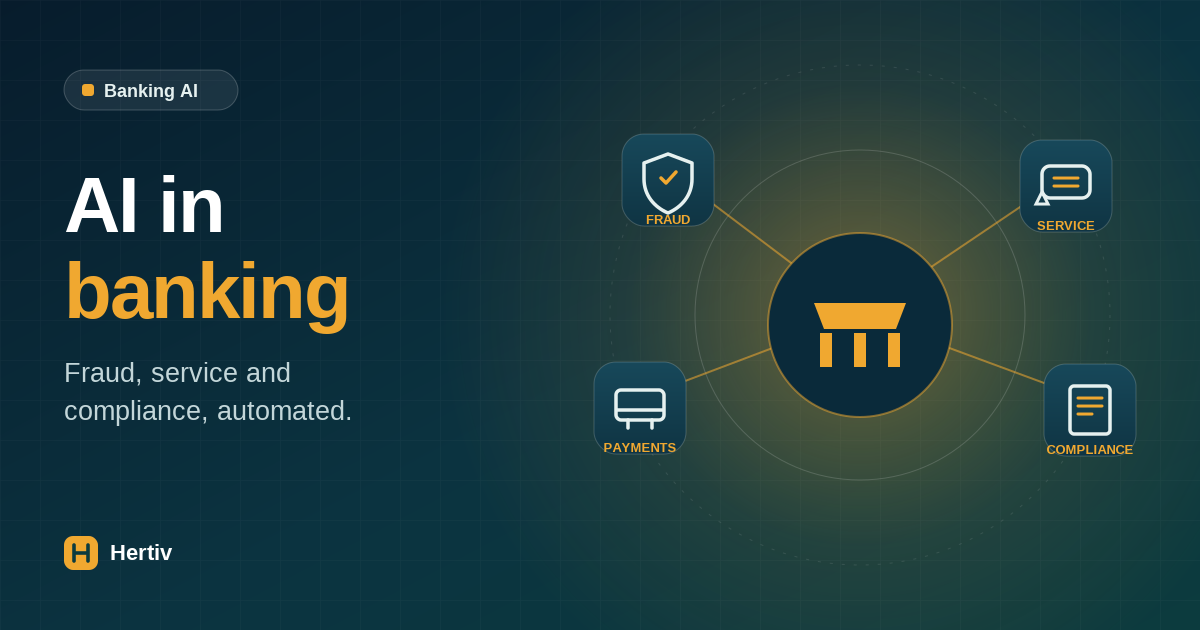
AI in banking and fintech now runs fraud checks, customer service, payments and compliance. Here is where it works, what it needs, and how banks start.
On this page
Short answer
AI in banking and fintech is software that uses machine learning to spot fraud, check identity, answer customer questions, route payments and flag risky transactions. It works on the data banks already hold, and it is usually added one workflow at a time rather than as a single system.
What are AI solutions for banking and fintech?
AI solutions for banking and fintech are software systems that use machine learning to do jobs that used to need a person reading documents or watching transactions: spotting fraud, checking identity, answering questions, sorting payments and flagging suspicious activity.
They sit on top of the systems a bank already runs. A fraud model reads the transaction stream in real time, a document model reads statements and identity papers, and a chat model answers routine questions using the bank's own help content. None of them replaces the core banking system; they work around it.
The difference from a lending-focused AI project is scope. Lending AI scores credit and prices loans, which is covered in our guide to AI solutions for fintech and lending. Banking AI covers the wider operation: payments, accounts, compliance and service, where the volume of routine work is the main cost.
Where does AI work in a bank today?
AI works in a bank today wherever there is a high volume of similar decisions and a record of past outcomes to learn from. Fraud, customer service and compliance checks are the most common starting points because the data already exists.
| Area | What the AI does | Typical result |
|---|---|---|
| Fraud detection | Scores each payment for risk in real time | Suspicious payments flagged before they clear |
| Customer service | Answers routine questions from help content | Fewer calls for password and balance queries |
| Identity checks | Matches documents and faces at onboarding | Faster account opening with fewer manual reviews |
| Payments | Routes and reconciles transfers | Fewer failed or stuck payments |
| Compliance | Screens transactions against watchlists | Alerts raised with a reason attached |
| Operations | Reads statements, forms and emails | Less manual data entry |
Fraud detection is usually first because the payoff is direct: a blocked fraudulent payment is money saved, and the model improves as it sees more labelled cases. Customer service comes next because the questions repeat and the answers already exist in the bank's help pages.
Compliance is slower to automate because the stakes are regulatory. Most banks use AI to sort and prioritise alerts, while a person still makes the final call on whether a transaction is reported. That split, machine triage plus human decision, is the pattern across the bank.
How does AI change fraud detection and compliance?
AI changes fraud detection and compliance by scoring every transaction as it happens and by sorting the alert queue so analysts look at the riskiest cases first, instead of working through alerts in the order they arrived.
A fraud model learns what normal looks like for each customer: typical amounts, places, times and devices. A payment that breaks the pattern gets a risk score, and high scores trigger a hold, a step-up check or a call to the customer. The model does not decide alone; it ranks, and a rule or a person decides what happens next.
For compliance, the same approach sorts transaction monitoring alerts. A bank can receive thousands of alerts a day, and most are false alarms. A model that ranks them by risk lets analysts spend their time on the cases that matter, and each decision they make becomes training data for the next round.
The limit is that a model is only as good as its labels. If past fraud cases were poorly recorded, the model learns the wrong pattern. Clean labelling of confirmed fraud, confirmed false alarms and the reasons behind each decision is the unglamorous work that makes the system work.
What does AI do for customer service and payments?
AI does the routine work in customer service and payments: answering repeated questions, resetting access, tracking transfers and preparing the summary a human agent needs when a case is passed on.
In service, a chat or voice assistant handles the questions that have a fixed answer: balances, recent transactions, card status, branch hours and how to dispute a charge. It should hand over to a person when the request is unclear, the amount is large, or the customer is upset. A handover that carries the full context, what was already tried and what the customer said, is what separates a useful assistant from an annoying one.
In payments, AI helps with routing and reconciliation. It matches incoming payments to invoices, flags transfers that are likely to fail, and suggests the cheapest or fastest route for a cross-border payment. The amounts involved mean these systems need tight controls: every automated payment should be logged, reversible where possible, and covered by a limit.
None of this removes the need for people. It removes the repetitive half of the job, which is why banks that measure success by cases resolved without a human, rather than by chat volume, get the honest picture.
How does a bank start with AI?
A bank starts with AI by picking one workflow with clear data and a measurable outcome, proving it on a small scale, and only then widening the scope to the next workflow.
- Pick one workflow. Choose a job with volume, existing data and a clear success measure, such as fraud alerts triaged or routine questions answered without a human.
- Check the data. Confirm the records are labelled, complete and accessible. If the fraud labels are messy, fix the labelling before building the model.
- Set the guardrails. Decide what the model may do alone, what needs a human, and what the limits are. Write these down before launch.
- Run a pilot. Put the model on a small share of real traffic with a human reviewing its decisions, and measure the outcome for a month.
- Review with compliance. Show the regulator-facing team how the model decides, what data it uses and how it is monitored. Get their sign-off before scaling.
- Scale one workflow at a time. Move to the next workflow only after the first is stable, monitored and understood by the team that runs it.
Regulators expect banks to explain their models, so documentation is part of the build, not an afterthought. If your team needs help scoping the first project, a partner for AI agents for finance teams can help shape the pilot and the guardrails together.
Example (hypothetical): a bank's first AI project
Example (hypothetical): a bank with 200,000 customers receives about 5,000 transaction monitoring alerts a month, and analysts review each one in the order it arrived. Only about 1 in 20 alerts turns out to matter, so most analyst time goes to false alarms.
The bank builds a ranking model on two years of labelled alerts. In the pilot, the model scores each new alert and analysts work from the highest score down. In the first month, the top 1,000 alerts contain 80 of the 100 real cases, while the bottom 2,000 contain only 2.
Analysts now clear the high-risk queue first and sample the low-risk tail instead of reading everything. Review time per month falls from about 800 hours to about 500 hours, and the 300 saved hours go to deeper checks on the cases that matter. The model itself is reviewed monthly, and any drift in the scores is investigated before it affects decisions.
What are the common mistakes?
The most common mistakes are starting with too many workflows at once, trusting a model without human review, and building on data that was never cleaned or labelled.
- Too many pilots at once. Five half-finished pilots teach less than one finished one. Pick a single workflow and see it through.
- No human in the loop. A fraud or compliance model that acts alone will eventually block a good customer or miss a real case. Keep a person on the decisions that matter.
- Dirty data. A model trained on poorly labelled fraud cases learns the wrong pattern. Fix the labels before the model.
- No monitoring. Models drift as customer behaviour changes. If nobody watches the scores, the model quietly gets worse.
- Ignoring the regulator. Banking models need explanations and audit trails. Build the documentation with the model, not after it.
Key takeaways
- AI in banking covers fraud, service, payments and compliance — lending is a separate, narrower job
- Fraud and compliance models rank risk; people still make the final decision on what matters
- Customer service AI should hand over to a person with the full context attached
- Start with one workflow, prove it on a small pilot, then widen the scope
- Clean labels and monitoring matter more than the choice of model
- Regulators expect explanations and audit trails, so document as you build
Frequently asked questions
How is AI in banking different from AI in lending?
Lending AI focuses on credit scoring and loan pricing for one decision: whether to lend and at what rate. Banking AI covers the wider operation, including fraud detection, customer service, payments and compliance, where the volume of routine work is the main cost. The two overlap on fraud checks but solve different problems.
Can AI approve or block payments on its own?
It can score and flag them, but most banks keep a person or a fixed rule on the final decision for anything large or unusual. Low-value routine payments may be automated within set limits, with logging and the ability to reverse. The split depends on the bank's risk policy.
What data does a bank need to start?
Labelled history for the workflow you pick: confirmed fraud cases and false alarms for fraud, past chats and their outcomes for service, and complete transaction records for compliance. If the labels are messy, cleaning them comes before building the model.
How long does a first banking AI project take?
A focused pilot usually takes a few months from data check to live traffic, with most of the time spent on data, guardrails and compliance review rather than on the model itself. Scaling to more workflows takes longer and depends on the first pilot staying stable.
Does AI replace bank staff?
It replaces repetitive tasks, not the staff who handle exceptions, complaints and complex cases. Banks that measure success by cases resolved without a human, and by customer satisfaction, get a clearer picture than those that count chat volume alone.
What should a bank check before buying an AI product?
Check what data it needs, how it explains its decisions, how it is monitored, and whether it fits your compliance rules. Ask for a pilot on your own data before signing, and make sure your team, not only the vendor, can run and review it.


