AI-Powered Project Cost Estimation: How It Works
AI cost estimation predicts project cost from past project data. Learn what data it needs, how accurate it is, and the mistakes to avoid.
On this page
Short answer
AI-powered project cost estimation uses a machine learning model trained on past project data to predict what a new software project will cost. This guide explains how it works, what data it needs, how accurate it is, and the mistakes to avoid.
What is AI-powered project cost estimation?
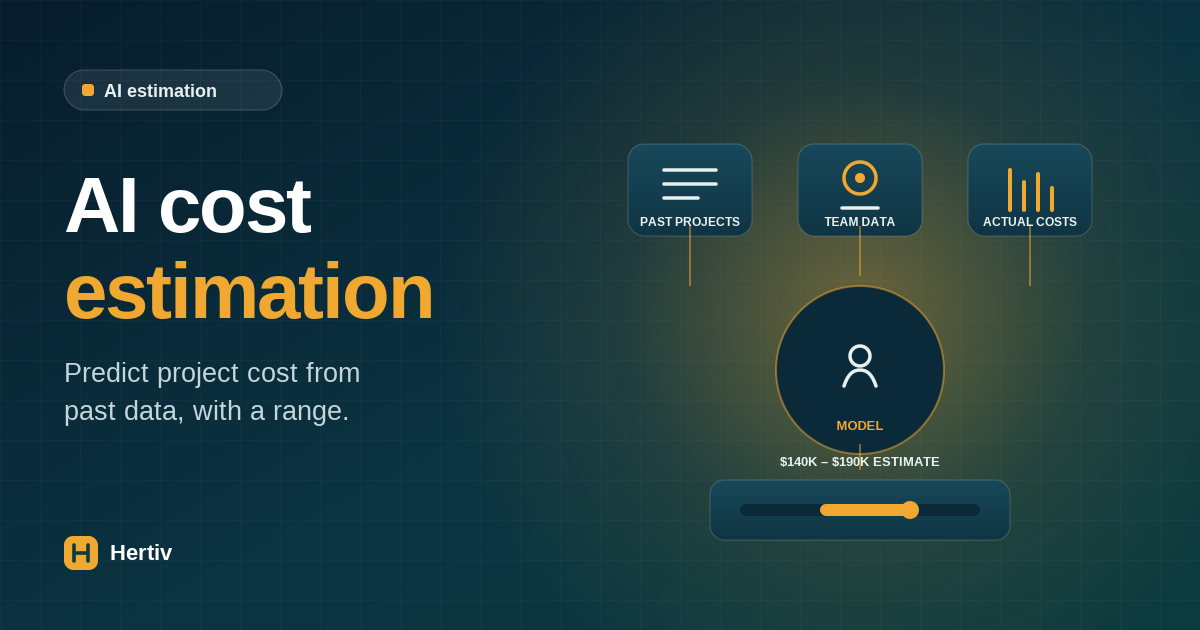
AI-powered project cost estimation is the use of a machine learning model to predict what a software project will cost, based on data from past projects. The model reads features such as team size, scope, technology and past delivery times, and returns an estimate with a range instead of a single number.
Traditional estimation relies on expert judgement or fixed formulas. An AI model adds a third source: patterns in the team's own history. If similar projects ran over by a third, the model will say so, even when the team is confident this time will be different.
The output is a forecast, not a promise. A good estimate shows the most likely cost, the range, and which factors drive it. That is what makes it useful in a budget meeting: the team can see where the risk sits. A guide to measuring AI return on investment shows how to judge whether the model pays for itself.
| Input | What it is | Why it matters |
|---|---|---|
| Scope | Features, screens, integrations | The biggest cost driver |
| Team | Size, seniority, location | Sets the daily rate |
| History | Past estimates versus actuals | Corrects for optimism |
| Risk | New tech, unclear requirements | Widens the range |
| Timeline | Deadline and milestones | Shows the effect of compression |
How does AI estimate a project cost?
An AI cost model works in three steps: it learns from past projects, it reads the new project's features, and it returns an estimate with a confidence range. The quality of the estimate depends almost entirely on the quality of the past data.
First, the team collects past project records: the original estimate, the actual cost, the team size, the scope and the outcome. A model trained on five projects will guess badly; one trained on fifty has a chance. Data cleaning matters more than the choice of algorithm.
Second, the model is trained to map features to cost. Common choices are gradient-boosted trees or a simple regression, because both explain which features mattered. Third, the team checks the model against projects it has not seen, and only then uses it on a live estimate.
- Collect past projects. Gather estimates, actuals, scope and team data in one place.
- Clean the data. Fix missing values and agree on what counts as a feature.
- Train a simple model. Start with regression or boosted trees, not a deep network.
- Test on unseen projects. Hold out recent projects and check the error.
- Use it with a human. Let the model suggest; let the estimator decide.
What data does the model need?
The model needs past project data with both the estimate and the actual cost, plus the features that explain the gap. Without actuals, the model can only repeat the team's past guesses, including the optimistic ones.
The most useful features are scope size, team size and seniority, the number of integrations, whether the technology was new to the team, and how clear the requirements were at the start. Each of these moves the cost in a predictable direction.
Small teams often have too little data to train a model from scratch. In that case, the practical option is a pre-built estimation tool or a model trained on industry data, then tuned with the team's own projects as they accumulate. A guide to building an AI proof of concept covers the same small-data problem for other AI projects.
| Data | Minimum useful amount | What happens without it |
|---|---|---|
| Past projects | 20 or more with actuals | The model repeats past guesses |
| Scope records | Features and screens listed | Estimates miss hidden work |
| Team records | Size and seniority per project | Rates are guessed, not measured |
| Risk notes | What went wrong, in writing | The same risks repeat |
| Timeline data | Planned versus actual dates | Compression effects are missed |
How accurate is AI cost estimation?
AI cost estimation is more accurate than a single expert guess when the data is good, and worse when the data is thin or dirty. The honest answer is that accuracy varies, and the model should always show its range so the team can see the uncertainty.
A useful way to judge accuracy is the average error on past projects the model has not seen. If the model is off by 10 to 15 percent on average, it is doing well for software work. If it is off by 40 percent, the data or the features are the problem, not the algorithm.
Accuracy also improves over time. Each finished project adds a record, and each record sharpens the next estimate. Teams that feed actuals back into the model see the error fall as the data grows, which is the main reason to start collecting data even before building the model.
Example: estimating a customer portal rebuild
Example (hypothetical): a 12-person agency needs to estimate a customer portal rebuild with 40 screens, 3 integrations and a 4-month deadline. The team has 30 past projects in its data, and the model returns a range of $140,000 to $190,000, with a most likely cost of $165,000.
The team checks the arithmetic behind the range. The model bases the estimate on 2,200 hours at $75 an hour, which is $165,000. The low end assumes the integrations go smoothly at 1,900 hours, or $142,500. The high end assumes one integration slips and adds 300 hours, taking the total to 2,500 hours, or $187,500.
The estimator also reads the model's drivers. Scope is the biggest factor, followed by the new payment integration. The team adds a note to the client: the estimate holds if the payment integration uses the vendor's standard flow, and it grows if custom rules are needed.
After the project, the actual cost is $172,000, inside the range and $7,000 above the most likely figure. The team adds the record to the data, and the next estimate gets a little sharper.
What are the limits of AI cost estimation?
The main limit of AI cost estimation is that it cannot see what is not in the data. A new technology, a new client, or a requirement nobody has built before will be estimated badly, because the model has no similar past project to learn from.
The model also cannot judge people. It does not know that a key developer is leaving, that the client changes its mind often, or that two teams have never worked together. Those are the factors that most often break an estimate, and they need a human to spot them.
Finally, the model can bake in past bias. If the team always underestimates testing, the model will learn that pattern only if the data records it. If testing time was never recorded, the model cannot correct for it. Clean, honest records are the real work behind AI estimation.
What are the common mistakes?
The most common mistakes in AI cost estimation are training on too little data, trusting the point estimate, and skipping the feedback loop. Each one turns a useful tool into a source of false confidence.
Training on a handful of projects produces a model that looks precise and is wrong. Trusting the single most likely figure hides the range, which is where the real information lives. And skipping the feedback loop means the model never learns from its own errors.
The fix is simple: collect data first, show the range, and feed every finished project back into the model. A team that does those three things gets a tool that improves with use.
- Too little data. Fewer than 20 past projects with actuals is not enough to trust.
- Hiding the range. A single number looks confident and is usually wrong.
- No feedback loop. Actuals that are never recorded cannot improve the model.
- Ignoring new risks. The model cannot see a technology or client it has never met.
- Replacing the estimator. The model suggests; a human still owns the number.
Key takeaways
- AI cost estimation predicts project cost from past project data, with a range
- The model needs past estimates and actuals, not just the estimates
- Start with simple models and test them on projects the model has not seen
- Show the range and the cost drivers, never a single fixed number
- Feed every finished project back into the data so the model improves
Frequently asked questions
How much data do I need for AI cost estimation?
Aim for at least 20 past projects with both the original estimate and the actual cost, plus scope and team details. With fewer records, the model will guess badly. Small teams can start with a pre-built tool and tune it as their own data grows.
Is AI cost estimation better than expert judgement?
It is better as a second opinion, not as a replacement. The model spots patterns in past data that a person may miss, but it cannot judge new risks, team changes or client behaviour. The best results come from a model plus an experienced estimator.
What tools do AI cost estimation?
Options range from spreadsheets with a regression model to dedicated estimation tools and custom models built on the team's own data. Start simple: a spreadsheet model on clean past data often beats a complex tool on messy data.
How do I know if the model is accurate?
Hold out recent projects the model has not seen and compare its estimates with the actual costs. If the average error is 10 to 15 percent, the model is doing well for software work. Track the error over time as the data grows.
Can AI estimate a project with new technology?
Not well. A model learns from past projects, so a technology it has never seen has no pattern to follow. For new technology, rely on expert judgement and add a wider range, then record the actuals so the next estimate is better.
Does AI cost estimation replace the project manager?
No. The model produces a number and a range; the project manager still owns the plan, the risks and the client conversation. AI estimation is a tool for the estimator, not a substitute for one.


