AI in Order Management: From Click to Delivery
AI in order management checks each order, picks the best place to ship it from and warns customers before a delay. Here is how it works and how to start.
On this page
Short answer
AI in order management is software that reads each order as it arrives, checks the payment and the stock, picks the best warehouse or shop to ship it from, tracks it to the door and sorts the return if it comes back. It helps shops fulfil orders faster, with fewer mistakes and fewer calls to support, while people still set the rules and handle the hard cases.
What is AI in order management?
AI in order management is software that reads each order as it arrives and decides what should happen to it, step by step, until it reaches the customer. It checks the payment, confirms the stock, picks where the order ships from, watches the delivery and sorts the return if the customer sends it back.
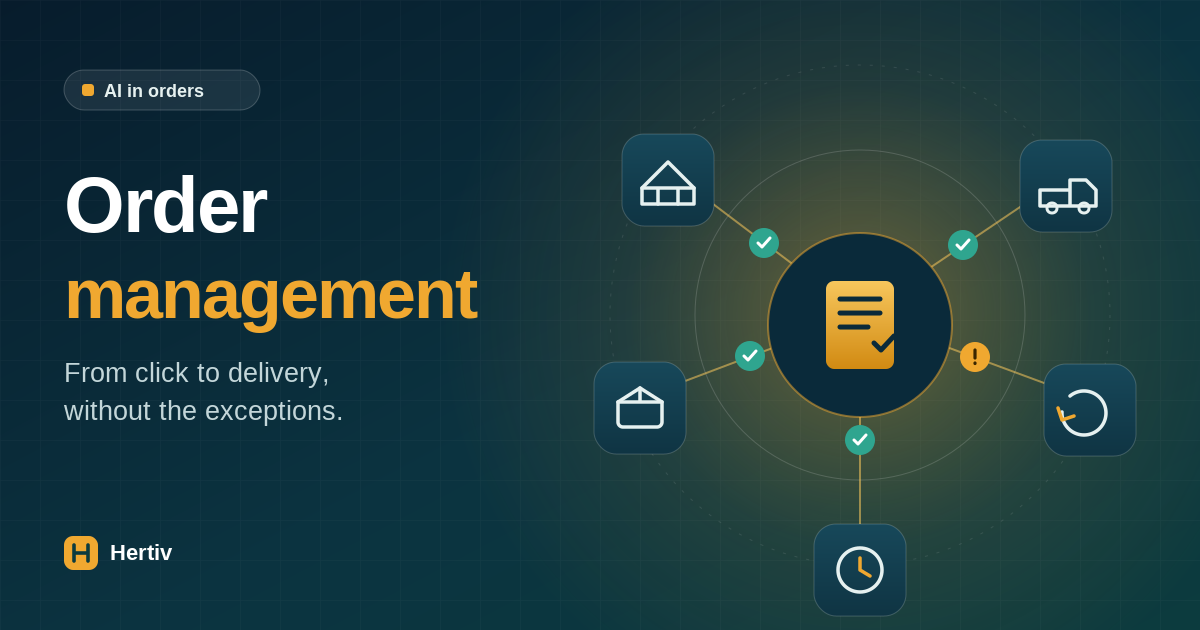
The work falls into five stages, and the model hands the order from one stage to the next:
| Stage | What the AI does | What people still decide |
|---|---|---|
| Order check | Validates payment, address and stock | Fraud rules and blocked orders |
| Sourcing | Picks the best place to ship from | Which sites can fulfil |
| Picking and packing | Orders the work for the warehouse | Staffing and shift plans |
| Delivery | Tracks the parcel and predicts arrival | Carrier choices and refunds |
| Returns | Sorts returns and restocks what is fit | Refund policy and exceptions |
Most teams start with the order check, because a bad order caught early costs far less than one caught after packing. The other stages follow once the team trusts the first checks. For the agent version of this work, see order management AI agents.
How does AI handle an order when it arrives?
AI handles a new order by checking it against the rules before anyone picks a product. It confirms the payment went through, the address is deliverable, and the items are actually in stock at a site that can ship them. An order that fails any of those checks is held for a person instead of flowing to the warehouse.
The check also looks for fraud signals: a new account ordering high-value goods, a delivery address that does not match the billing address, or several orders in a few minutes from the same device. The model scores the risk and either clears the order, holds it, or asks for an extra check such as confirming the card.
Good checks cut two kinds of cost. They stop orders that would have been picked, packed and then cancelled, and they stop genuine orders from being held for no reason. Teams tune the rules by watching both: how many bad orders slipped through, and how many good customers were wrongly held.
How does AI pick where the order ships from?
AI picks the shipping source by weighing stock, distance, cost and promised delivery date across every site that holds the items. An order might ship whole from one warehouse, or split across two sites if that gets it to the customer sooner. The model scores each option and picks the one that best fits the promise made at checkout.
Splitting an order is a trade-off. Two parcels cost more to ship, but they can arrive sooner than waiting for one site to restock. The model makes that call per order, using the delivery date promised, the stock on hand and the shipping cost, instead of applying one rule to every order.
The choice also protects stock. If one warehouse is nearly out of a popular item, the model can hold its remaining stock for orders that can only ship from there, and send the rest from other sites. That keeps more orders shippable instead of letting one busy site run dry. For the wider stock picture, see AI in the supply chain.
How does AI handle delays and exceptions?
AI handles delays by watching each parcel against its promised date and warning the team before the customer notices. It reads carrier scans, warehouse queues and weather or traffic signals, then predicts which parcels will miss their date. The team can then act: reroute the parcel, send a replacement, or message the customer first.
Messaging the customer first is the part that saves the most support calls. A short note saying the parcel will arrive a day late, with the new date, stops the customer from calling to ask. The model drafts the note from the tracking data, and a person reviews it before it goes out for sensitive cases.
Exceptions also include damaged parcels, wrong items and failed deliveries. The model sorts these into groups, such as reship, refund or collect, so the team works through them in order of impact instead of in the order they arrived. The hardest cases still go to a person.
How does AI handle returns?
AI handles returns by sorting each one as soon as the customer asks for it. It reads the reason, the item and the order history, then decides the fastest path: instant refund for a low-value item, a return label for something that can be resold, or an inspection step for a high-value or damaged item.
It also predicts whether the returned item can be sold again. A sealed item in its original box can go straight back to stock, while a used or damaged one needs repair, discounting or disposal. Sorting that out at the point of return, rather than in a warehouse pile weeks later, keeps more stock sellable.
Returns data feeds back into the rest of the business. If one product comes back far more often than the rest, the model flags it, and the team can check the sizing, the description or the quality. That loop turns returns from a cost into a source of fixes.
How do you start using AI in order management?
You start by picking one stage with a clear measure of success, then proving the model helps before you widen its role.
- Pick one stage. The order check or delivery tracking are good first picks. Define success, such as fewer orders held wrongly or fewer 'where is my order' calls.
- Connect the data. Bring together orders, stock, carrier tracking and returns so the model sees the whole journey, not one step.
- Run it beside the team. Let the model suggest decisions for a few weeks while people still make the final call, and compare the results.
- Feed back the results. Confirm or correct the model's calls so it learns which orders to hold, which to split and which to reroute.
- Move the routine decisions over. Once the model is right often enough, let it clear routine orders and send routine updates on its own, with a person watching the exceptions.
- Expand one stage at a time. Add sourcing or returns next, using the same data and the same team.
Keep a person in charge of the rules throughout. The model can check, sort and predict, but only people can set the fraud rules, the refund policy and the delivery promise. For the buying side of the same journey, see AI in purchase order management.
Example (hypothetical): an online shop clears its exception queue
Example (hypothetical): an online shop takes 4,000 orders a week, and about 200 of them land in an exception queue each week: bad addresses, failed payments, stock shortfalls and late parcels. Two staff spend around 15 hours a week clearing the queue by hand.
The shop adds a model that checks each order as it arrives. In the first month it clears 120 of the 200 weekly exceptions on its own: 60 bad addresses fixed by address lookup, 40 payments retried on a second route, and 20 stock shortfalls rerouted to another warehouse. The queue falls from 200 to 80 a week.
At 15 hours for 200 exceptions, each exception costs about 4.5 minutes, so clearing 120 of them saves about 9 hours a week. The team uses that time on the 80 hard cases left, and the share of orders delivered on the promised date rises from 94 in 100 to 97 in 100.
What are the common mistakes?
The most common mistakes are trusting the model too early, feeding it stale stock data, and leaving customers in the dark when a parcel is late.
- Letting the model decide too soon. A model that has not seen enough real orders will hold good ones and clear bad ones. Run it beside the team first.
- Stale stock data. If the stock feed lags, the model promises items that are not there. Fix the feed before adding the model.
- Silent delays. A late parcel with no message costs more in support calls and lost trust than the delay itself. Message first.
- One rule for every order. A high-value order and a low-value one need different checks. Let the model weigh value, not just speed.
- Ignoring returns. Returns are part of order management. If the model never sees them, it keeps repeating the same mistakes.
Key takeaways
- AI in order management checks each order before anyone picks a product
- Sourcing picks the best site per order instead of one rule for all
- Delay warnings and early messages cut support calls
- Returns sorted at the point of return keep more stock sellable
- Start with one stage, run beside the team, then expand
Frequently asked questions
What is AI in order management?
It is software that reads each order as it arrives, checks the payment and the stock, picks the best place to ship it from, tracks the parcel and sorts the return. People still set the fraud rules, the refund policy and the delivery promise.
Can AI really pick where an order ships from?
Yes. It weighs stock, distance, cost and the promised delivery date across every site that holds the items, and it can split an order across two sites when that gets it to the customer sooner. Teams set which sites can fulfil and the cost limits.
Does AI in order management replace the warehouse team?
No. It takes over the checking, sorting and routing decisions, while people pick, pack, fix machines and handle the hard cases. Most teams use the saved time on exceptions and customer contact rather than cutting headcount.
What data does it need?
It needs orders, stock levels, carrier tracking and returns in one place, plus the delivery promise made at checkout. If the stock feed lags or the tracking data is patchy, the model will make bad calls, so fix the feeds first.
How is this different from an order management AI agent?
An agent is a product that takes over tasks such as checking orders and chasing carriers, while AI in order management is the wider practice of using models across every stage, from the order check to returns. Many teams use both together.
What if our orders are mostly in-store pickup?
The same checks apply: the model confirms the stock at the pickup store, holds the item and tells the customer when it is ready. Pickup orders usually need fewer routing decisions, so teams often start with the order check and the pickup message.


