AI in Medicine: How Doctors Use It Today
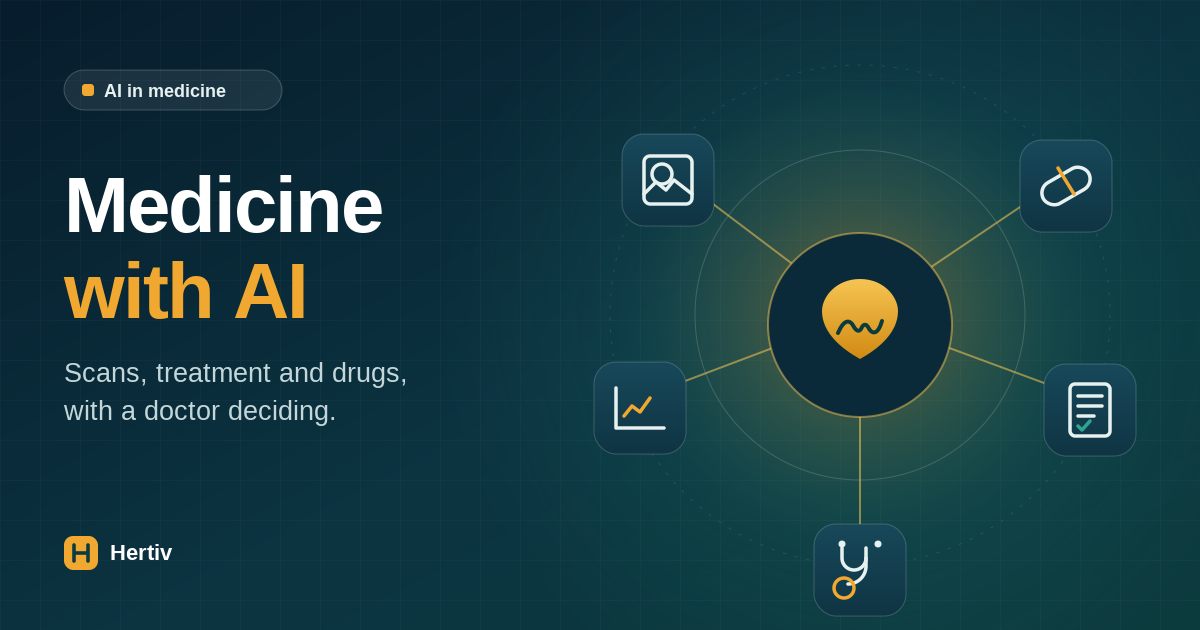
AI in medicine helps doctors read scans, weigh treatment options, find new drugs and cut paperwork. It works best as a second pair of eyes for the doctor.
On this page
Short answer
AI in medicine is software that reads scans and records, flags patterns a clinician should check, and speeds up drug discovery and paperwork. It helps with diagnosis, treatment planning and admin, but the doctor stays responsible for the decision and the patient.
What is AI in medicine?
AI in medicine is software that reads medical data — scans, test results, patient records and research papers — and turns it into useful signals for a doctor. It covers tools that spot early signs of disease in an image, systems that suggest treatment options from a patient's history, software that searches for new drugs, and tools that draft notes and letters.
The software does not practise medicine. It ranks patterns and suggests what to check, and a clinician decides what to do. That split matters: the tool is fast at reading large amounts of data, while the doctor is good at weighing a whole person — their history, their wishes and the risks of each option.
| Area | What AI does | Who decides |
|---|---|---|
| Diagnosis | Flags patterns in scans and tests | The doctor |
| Treatment planning | Suggests options from patient history | The doctor and patient |
| Drug discovery | Searches molecules and trial data | Researchers and regulators |
| Monitoring | Watches readings and flags change | The care team |
| Admin | Drafts notes, letters and summaries | The doctor, who signs them |
Medicine is a wide field, so this article covers what doctors use today. For the narrower picture of scans alone, see AI in radiology.
For treatment matched to one person, see AI in personalized medicine.
How does AI help with diagnosis?
AI helps diagnosis by reading data a doctor cannot read at the same speed. A tool trained on many scans can flag a small mark on an X-ray or a change between two scans taken months apart, and put the flagged cases at the top of the worklist so the urgent ones are read first.
The same idea works on test results and records. A system can pull together blood results, past visits and current medicines, and point out a combination that suggests a condition worth testing for. The doctor still makes the diagnosis, but the tool makes sure the relevant facts are in front of them at the right time.
The risk is over-trust. A tool that is right most of the time can still be wrong on an unusual case, and a doctor who stops checking will miss it. Good teams treat every AI flag as a suggestion to verify, not as an answer, and they track how often the tool is right so they know when to doubt it.
How does AI help with treatment planning?
Treatment planning is where AI turns a patient's whole record into options. A system can read the diagnosis, the patient's age and other conditions, the medicines they already take, and the latest guidance, then list the treatments that fit and flag the ones that clash with something the patient already has.
That list is a starting point, not a prescription. The doctor weighs the options against what the patient wants — some patients prefer the gentlest option, others the fastest — and against the risks that only a person in the room can judge. The tool saves the time of gathering the facts; the decision stays human.
AI also helps after treatment starts, by watching how a patient responds. If readings or test results move the wrong way, the system can flag it early so the plan can change sooner. That kind of watching is close to what AI in remote patient monitoring does at home, and the two often run together.
How does AI help find new drugs?
Finding a new drug starts with searching a huge space of possible molecules, and AI is good at that kind of search. A model can predict which molecules are likely to bind to a target, which are likely to be toxic, and which already-approved drugs might work for a different disease — work that would take a human team far longer to screen.
The second job is reading trial data. When a trial runs, AI can sort patients, spot side effects early and pull together results from many small studies into one picture. That does not replace the trial itself: a drug still has to be tested in people and approved by a regulator before it reaches patients.
The limits here are real. A molecule that looks good on a screen can fail in the body, and a model trained on past trials can miss a risk that has never been seen before. Drug teams use AI to shorten the search, not to skip the testing.
How does AI cut admin work?
Admin is where most doctors feel AI first. A tool that listens to a consultation and drafts the note, or that turns a pile of test results into a short summary, can give a doctor back the time they used to spend typing after each patient. The doctor still reads and signs every note; the software only prepares a draft.
The same tools help with letters and forms. Referral letters, insurance forms and discharge summaries all follow patterns, and AI can fill in the routine parts from the record, leaving the doctor to check the facts and add the judgement. Clinics that do this well set a rule: nothing leaves the building without a human reading it first.
There is a second gain that is easy to miss. When notes and letters are written faster, the record itself gets better — more complete, more consistent and easier for the next clinician to read. That helps the next doctor more than it helps the one who saved the time.
How do you start using AI in a clinic?
Start with one job that is slow, routine and easy to check, such as drafting notes or summarising records. Pick a tool that has been tested in a setting like yours, and keep a clinician in charge of every output. The steps below fit a small clinic or a hospital team adding its first AI tool.
- Pick one job. Notes, summaries or triage — and write down what good looks like before you buy.
- Check the rules. Find out where patient data goes, who can read it, and whether the tool meets your local health privacy rules.
- Run a small trial. Use it with a few willing clinicians for a month and compare the drafts against their usual notes.
- Set the review rule. Decide who checks every output and how fast, before the tool goes live.
- Review the results. Check accuracy, time saved and whether patients noticed any change, then decide whether to keep it.
Do not start with diagnosis. Tools that suggest a diagnosis carry the most risk and need the most checking, so they belong later, once the team trusts the simpler tools and has review habits in place.
Example (hypothetical): a hospital group cuts reporting time
A hospital group with six doctors asks an AI tool to draft discharge summaries, which each doctor used to write by hand. Before the change, each doctor wrote about 10 summaries a week, taking about 20 minutes each, which is about 200 minutes — just over 3 hours — per doctor per week.
With the tool, each doctor spends about 5 minutes checking and fixing a draft instead of 20 minutes writing. The numbers add up like this: 60 summaries a week at 5 minutes each is 300 minutes, or 5 hours across the team, against 20 hours a week before. That saves about 15 hours a week, which the doctors use for longer patient visits and for clearing the referral backlog.
The group keeps one rule: no summary leaves the hospital until the doctor who treated the patient has read it. In the first month, the doctors find about 2 drafts in every 60 that need a real correction, usually a missing allergy or a wrong dose, which is why the review step stays. After three months, the group checks whether the time saved held up and whether any errors slipped through.
What are the common mistakes?
The first mistake is trusting the tool too far. A scan reader or a draft note is right most of the time, and that is exactly when people stop checking. Build the check into the workflow — a second reader for flagged scans, a read-through for every draft — so the check happens even on a busy day.
The second mistake is feeding the tool bad data. A model trained on records from one hospital can fail on patients from another, and a tool trained mostly on one group of patients can miss problems in another. Ask the vendor what data the tool was trained on and whether it was tested on patients like yours.
The third mistake is buying before the rules are clear. Patient data has strict privacy rules, and a tool that sends data to a server in another country can break them. Check where the data goes and who can read it before you sign, not after. For the longer view of where this field is heading, see the future of AI in healthcare.
Key takeaways
- AI in medicine reads scans, records and research, and turns them into signals a doctor can check.
- Diagnosis, treatment planning and drug discovery all get faster, but the doctor stays responsible.
- Admin tools that draft notes give doctors time back — with a human reading every output first.
- Start with one routine job and a small trial, not with diagnosis.
- Bad data and blind trust are the two biggest risks; check both before you buy.
Frequently asked questions
Can AI diagnose a disease?
AI can flag patterns that suggest a disease, such as a mark on a scan or an unusual combination of test results. But a diagnosis needs a trained doctor who can weigh the whole patient, order more tests and rule out other causes. An AI flag is a suggestion to check, not a diagnosis.
Will AI replace doctors?
No. AI handles routine reading, drafting and searching far faster than a person, but it cannot examine a patient, weigh their wishes or take responsibility for a decision. The doctors who use it well treat it as a second pair of eyes, not as a replacement.
Is my medical data safe with AI tools?
It depends on the tool and the rules where you live. Ask where your data goes, who can read it, how long it is kept and how you can delete it. A trustworthy tool answers those questions plainly and meets local health privacy rules.
How accurate is AI at reading scans?
Accuracy varies by tool, by the type of scan and by the patients it was trained on. A tool can be very good on common cases and weaker on rare ones. Ask the vendor for test results on patients like yours, and keep a human reading every flagged scan.
Can AI help find new medicines?
Yes, by searching far more molecules than a human team could, and by pulling together trial data faster. But a drug found this way still has to be tested in people and approved by a regulator before it reaches patients, so AI shortens the search rather than skipping the testing.
How much does AI in medicine cost?
It varies from small monthly tools for drafting notes to large hospital systems priced by quote. Check the vendor site for current pricing, and trial a tool with a small team before signing a contract.


