AI in Clinical Decision Making: Better Calls at the Bedside
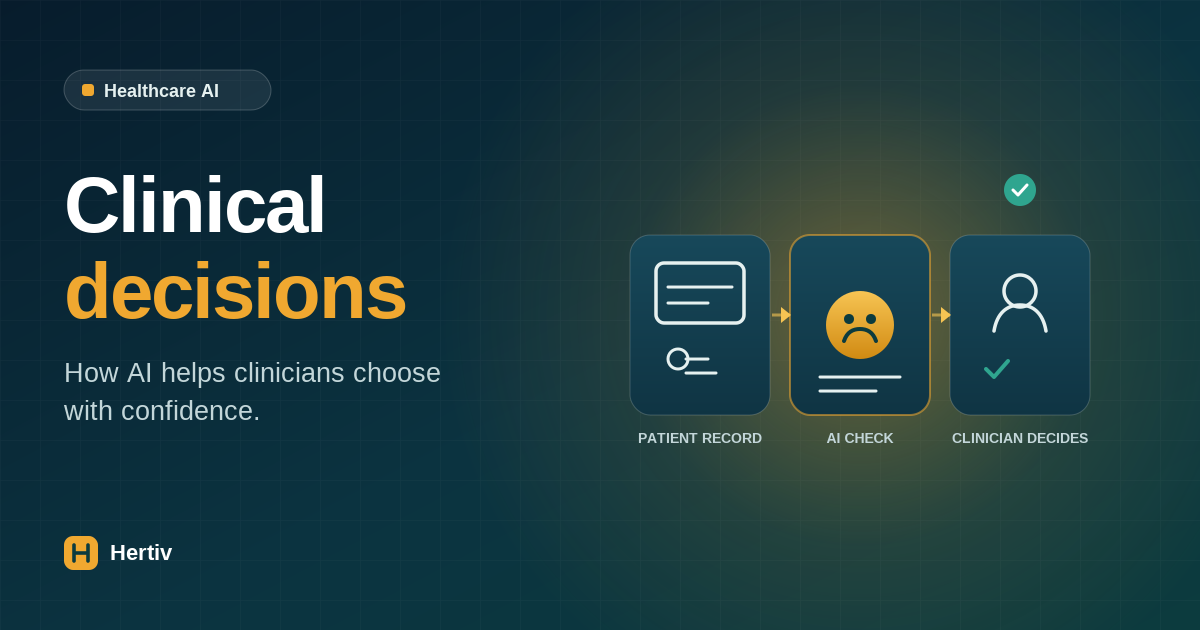
AI in clinical decision making helps clinicians weigh options at the point of care, from diagnosis to treatment choice. The clinician still decides.
On this page
Short answer
AI in clinical decision making is the use of machine learning to support the choices clinicians make during care: spotting likely diagnoses, comparing treatments, estimating risk and flagging what needs attention. It works best as a second opinion that shows its reasoning, with the clinician keeping the final call.
What is AI in clinical decision making?
AI in clinical decision making is software that helps a clinician choose between options while caring for a patient. It reads the record, the latest test results and the relevant guidelines, then offers a suggestion the clinician can accept, change or ignore.
It is different from software that only stores records or only books appointments. Decision support acts on the content of the case: it notices a pattern, checks it against what is known, and brings the finding to the clinician at the moment the choice is made.
| Decision point | What the AI adds | What the clinician still decides |
|---|---|---|
| Diagnosis | Shortlists likely conditions from symptoms and tests | Which diagnosis fits, and what to test next |
| Treatment choice | Compares options against similar past cases | What fits this patient and their wishes |
| Risk and prognosis | Estimates the chance of deterioration | How urgently to act and where to treat |
| Medication | Flags interactions, doses and allergies | Whether to prescribe and at what dose |
| Follow-up | Spots patients who need review sooner | When to call the patient back |
The key point is that the AI advises and the clinician decides. Systems that hide their reasoning get ignored, while systems that show the evidence behind a suggestion get used. For the software side of this, clinical decision support software explains how these tools sit inside the record.
How does AI help with diagnosis?
AI helps with diagnosis by comparing a patient's symptoms, history and test results against patterns learned from many past cases. It is most useful when the presentation is unusual or when several conditions could explain the same symptoms.
In practice the tool offers a shortlist, not a verdict. A clinician seeing a patient with chest pain might get three likely causes ranked by fit, each with the findings that support it and the test that would separate them. That saves time and reduces the chance of missing a less obvious cause.
Imaging is a strong example: models trained on scans can flag areas a tired reader might pass over, and the clinician then reviews the flagged region. The model does not replace the reader; it changes where the reader looks first. Diagnostic support also helps in settings with few specialists, where a general clinician can lean on the shortlist while arranging a referral.
How does AI help choose between treatments?
AI helps choose between treatments by showing how similar patients responded to each option. Instead of relying on memory or a single guideline, the clinician sees the trade-offs for a patient with this age, these conditions and this history.
For a patient with two possible drugs, the tool might show that one works slightly better on average but interacts with a medicine the patient already takes, while the other is safer but needs closer monitoring. That framing makes the conversation with the patient concrete: benefits, risks and what to watch for.
Treatment choice is where patient preference matters most, and no model can settle that. A treatment with a slightly better average outcome may still be the wrong choice for a patient who values avoiding a particular side effect. The AI supplies the comparison; the clinician and patient supply the values.
How does AI help with prognosis and risk?
AI helps with prognosis by estimating the chance that a patient will get worse, need admission or develop a complication. It does this by weighing many small signals at once: vital signs over time, lab trends, age, existing conditions and recent changes.
Early warning scores already do a version of this with a handful of numbers. AI extends the idea to the full record, so a slow drift across several measures can trigger a review before any single number looks alarming. In a ward, that means the sickest patients get attention earlier.
Risk estimates need care. A model trained on one hospital's patients may misjudge risk in another population, and a score that is wrong in the reassuring direction is dangerous. Teams should check the model on their own patients before trusting it, and re-check it as the patient mix changes.
How does AI support shared decisions with patients?
AI supports shared decisions by turning a clinical choice into something a patient can weigh. It can produce a plain-language summary of the options, the likely outcomes for each, and the questions worth asking.
For example, a patient choosing between surgery and watchful waiting might see the expected recovery time, the chance of needing further treatment and the main risks, side by side. The clinician then talks through what matters to that person, rather than starting from a blank page.
This only works if the summary is honest about uncertainty. A tool that presents a guess as a fact will mislead both sides. Good systems show ranges and say what is unknown, and clinicians should repeat that uncertainty in the conversation rather than smoothing it over.
Example (hypothetical): a Tuesday clinic with AI triage
Example (hypothetical): a clinic sees 40 patients on a Tuesday. Without AI, the clinician reviews each record from scratch, spending about 6 minutes per patient on history and results before the consultation, which is 40 times 6, or 240 minutes of preparation.
With AI support, the system prepares a one-page brief per patient and flags 8 cases that need a closer look. The clinician spends 2 minutes on each of the 32 routine briefs, which is 64 minutes, and 8 minutes on each of the 8 flagged cases, which is 64 minutes. Total preparation is 128 minutes, saving 112 minutes across the day.
The saving is only real if the briefs are accurate. The clinic checks this by sampling 10 briefs a week against the full record and tracking how often the flag was right. If accuracy slips, the team reviews the flagged cases first and retrains the routine before expanding use.
How do you start using AI in clinical decisions?
You start by picking one decision that is frequent, well documented and low risk if the AI is wrong, then running the tool in the background while clinicians work as normal.
- Pick one decision. Medication checks or follow-up timing are good first choices because the stakes are bounded and the data exists.
- Check the data. Make sure the record fields the model needs are filled in reliably; missing data is the most common cause of bad suggestions.
- Run it silently first. Let the tool score real cases for a month without showing results, then compare its suggestions with what clinicians actually did.
- Show the reasoning. Only put suggestions in front of clinicians when the tool can show the evidence behind each one.
- Set an owner. Name one clinician and one technical person who review accuracy monthly and can switch the tool off.
- Train the team. Teach clinicians what the tool does well, where it fails, and that ignoring it is always allowed.
Governance matters from the start. AI governance covers the review and accountability patterns.
The same evidence discipline applies in research: see AI in clinical trials for how it works there.
What are the common mistakes?
The most common mistakes are trusting the tool too quickly, feeding it bad data, and forgetting that the clinician is accountable for the decision.
- Treating a suggestion as an order. Clinicians who stop thinking and follow the screen will miss the cases the model gets wrong.
- Skipping the silent run. Showing suggestions before checking accuracy on local patients invites bad calls.
- Ignoring alert fatigue. Too many flags and clinicians start dismissing all of them, including the important ones.
- Forgetting the patient. A statistically better option can still be wrong for a patient with different priorities.
- No off switch. Every tool needs a named person who can disable it and a plan for working without it.
Key takeaways
- AI advises on diagnosis, treatment, risk and follow-up; the clinician keeps the final call
- Tools that show their reasoning get used; tools that hide it get ignored
- Run the tool silently for a month and check it against real clinician decisions first
- Risk estimates must be validated on your own patients, not just the vendor's data
- Shared decisions need honest uncertainty, not a single confident number
Frequently asked questions
Does AI replace clinical judgement?
No. AI shortlists diagnoses, compares treatments and estimates risk, but the clinician weighs the evidence, the patient's wishes and the context the record misses. The accountable decision stays with the clinician, and ignoring the tool must always be allowed.
What is the difference between AI decision support and CDSS?
They overlap heavily. CDSS is the software category that delivers guidance inside the record, while AI in clinical decision making is the broader practice of using machine learning to support choices. Most modern CDSS tools now include AI models.
Is AI in clinical decisions safe?
It can be, with the right controls: a silent validation run on local patients, suggestions that show their evidence, a human approval step for high-risk choices, and a named owner who can switch the tool off. Without those, the risk is real.
Which clinical decisions is AI best at supporting?
Frequent, well-documented decisions with clear data: medication checks, follow-up timing, triage and risk scoring. Rare or highly individual decisions, where data is thin and judgement matters most, are weaker candidates.
How do hospitals check whether a clinical AI tool works?
They run it silently on real cases and compare its suggestions with what clinicians actually did, then track accuracy on their own patients over time. A tool that performed well elsewhere still needs local validation before it goes live.
Can AI help patients make decisions too?
Yes, by turning options into plain-language comparisons with likely outcomes and risks side by side. That helps the conversation, but the numbers must show uncertainty honestly, and the clinician should talk through what matters to that patient.