How to Identify an AI Implementation Consultant in the Middle East
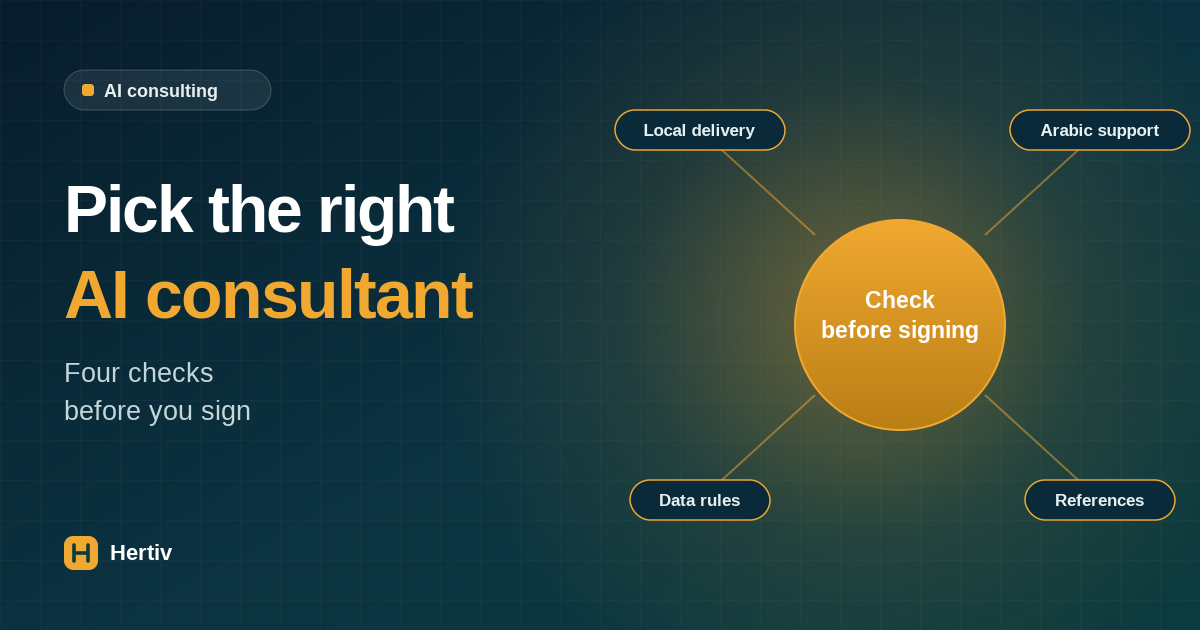
How to identify an AI implementation consultant in the Middle East: check local delivery, data rules, Arabic support and references before you sign.
On this page
Short answer
An AI implementation consultant in the Middle East is a firm or adviser that helps a company choose, build and run AI systems in the region. To identify a good one, check that it has delivered working systems for companies like yours in the Gulf, understands local data rules such as the UAE PDPL and Saudi PDPL, can work in Arabic and English, and can show references you can call.
What is an AI implementation consultant?
An AI implementation consultant is a firm or adviser that helps a company put AI to work: choosing the right use case, preparing the data, building or buying the system, and training staff to use it. The work ends with a system that runs in the business, not with a slide deck.
In the Middle East, the job has local parts. Data rules differ by country, Arabic language support matters for customer-facing systems, and many companies work across the UAE, Saudi Arabia and other Gulf states at once. A consultant who has delivered in the region knows these parts; one who has not will learn them on your budget.
| What they do | What good looks like | What to ask for |
|---|---|---|
| Find use cases | Uses cases tied to revenue or cost | A short list with expected gains |
| Check data readiness | Honest view of data gaps | A data audit before the build |
| Build or buy | Working system in weeks, not months | A pilot with a clear end date |
| Train staff | Staff who can run it alone | Training and handover plan |
| Governance | Clear rules for data and AI use | Written policy and checks |
The table shows the five jobs a consultant should cover. If a firm only sells strategy and never builds, it is not an implementation consultant.
What should you check before you hire one?
Check four things before you shortlist anyone: local delivery, data rules, language and references. A firm that passes all four is worth a meeting; a firm that fails one is worth a question, and a firm that fails two should be dropped.
Local delivery means the firm has built working AI systems for companies in the Gulf, not only in other regions. Ask which systems are live today, who uses them, and what they do each week. Data rules mean the firm can name the laws that apply to your data, such as the UAE PDPL and the Saudi PDPL, and can explain where your data will be stored.
Language matters when the system talks to customers: a chatbot or voice agent that only works in English will fail half the users in many Gulf markets. Ask to see the system working in Arabic. For a related view, the guide to building an AI proof of concept shows how a small pilot proves whether a consultant can deliver.
How to check a consultant's track record
A track record is only useful if you can verify it. Ask for three references from companies like yours, in the same country or a nearby one, and call all three. Ask each one what was delivered, what went wrong, and whether they would hire the firm again.
Also ask to see a live system, not a demo video. A demo can hide a system that never worked in production, while a live system shows the real interface, the real data and the real users. If the firm cannot show a live system, ask why: a good answer is that the client keeps it private, and the firm should then offer a reference call instead.
Check the team too. Ask who will actually work on your project, not only who sells it. A firm that shows senior people in the meeting and sends junior staff to do the work should say so clearly, and the price should match the team you get.
Example (hypothetical): a Dubai retailer compares two consultants
Imagine a Dubai retailer with 12 stores that wants an AI assistant to answer customer questions in Arabic and English. Two consultants bid. Firm A quotes a 12-week project and shows a live Arabic chatbot running for a retailer in Abu Dhabi. Firm B quotes 8 weeks at a lower price but shows only slides and a demo video.
The retailer calls Firm A's reference, who says the chatbot answers 60 of every 100 questions without a human, and that the project finished two weeks late. The retailer then runs a 4-week pilot with Firm A for one store. The pilot answers 55 of every 100 questions, and the retailer signs for the other 11 stores.
Example (hypothetical): the numbers above are invented to show how the check works, not a real project. The lesson is that a live system and a reference call are worth more than a lower price and a faster promise.
What should the contract include?
A good contract turns the promises into writing. It should name the pilot, the success measure, the data rules and the handover, so both sides know what done looks like before the work starts.
- A pilot with a date. Name the use case, the store or team, and the date the pilot ends.
- A success measure. Write down the number that decides whether the pilot worked, such as questions answered without a human.
- Data rules. State where data is stored, who can see it, and which local laws apply.
- The team. Name the people who will work on the project and what happens if they leave.
- Handover. Require training and documents so your staff can run the system after the consultant leaves.
If a firm will not put the success measure in writing, treat that as a warning sign. A consultant who is sure of the result will agree to be measured on it.
What are the red flags?
The clearest red flag is a firm that promises results before it has seen your data. No one can promise accuracy or savings without looking at the data first, and a firm that does is selling, not advising. Ask for a data audit before any promise.
Another red flag is a price that is far below the others. A very low price usually means a junior team, a reused system that does not fit your case, or extra charges later. Compare the team and the scope, not only the number.
A third red flag is no local presence at all. A firm with no staff and no clients in the region will struggle with time zones, local rules and Arabic support. That does not rule it out, but it should be able to explain how it covers those gaps.
What are the common mistakes?
The most common mistake is choosing on price alone. The cheapest bid often costs more in the end, because a system that does not work has to be rebuilt. Compare the team, the live systems and the references first, and treat price as the last check.
Another mistake is skipping the pilot. A company that signs a full project without a small pilot has no proof the consultant can deliver, and no easy way out if it cannot. A four-week pilot is cheap insurance.
A third mistake is forgetting handover. If the consultant leaves and your staff cannot run the system, you are locked into paying for support for ever. Insist on training and documents in the contract, and test that your staff can run the system before the final payment.
Key takeaways
- Check local delivery, data rules, Arabic support and references before you shortlist anyone.
- Ask for three references you can call, and ask to see a live system, not only a demo.
- Run a short pilot with a written success measure before you sign a full project.
- Put the team, the data rules and the handover in the contract.
- Price alone is a poor guide: the cheapest bid often costs more when the system has to be rebuilt.
Frequently asked questions
How much does an AI implementation consultant cost in the Middle East?
Fees vary by scope, team and country, so no single number is honest here. A short pilot usually costs far less than a full rollout, and most firms quote after a discovery call. Ask for a written quote for the pilot first, and see the vendor site for current terms.
Do I need a consultant based in the Middle East?
Not always, but local presence helps with data rules, Arabic support and time zones. A firm based elsewhere can work if it has delivered in the region and can show local references, but it should explain clearly how it covers those gaps.
What data rules apply to AI in the UAE and Saudi Arabia?
The UAE has the PDPL and Saudi Arabia has its own PDPL, and both set rules for personal data, storage and transfers. A consultant should be able to name the rules that apply to your data and say where your data will be stored.
How long should an AI pilot take?
Most pilots take four to eight weeks, depending on the use case and the state of the data. A pilot that takes longer usually means the data needs more work first, and the consultant should say so before the pilot starts.
Should the consultant build the system or buy one?
It depends on the use case. Buying a ready system is faster when one fits, while building is better when the work is specific to your business. A good consultant will compare both and explain the trade-off instead of selling only one.
What if the pilot fails?
A failed pilot is useful if you learn why it failed and what it would take to fix it. Agree before the pilot what happens next: fix it, change the use case, or stop. The contract should say who pays for each option.


