AI for Policy Documentation: Drafts That Stay Current
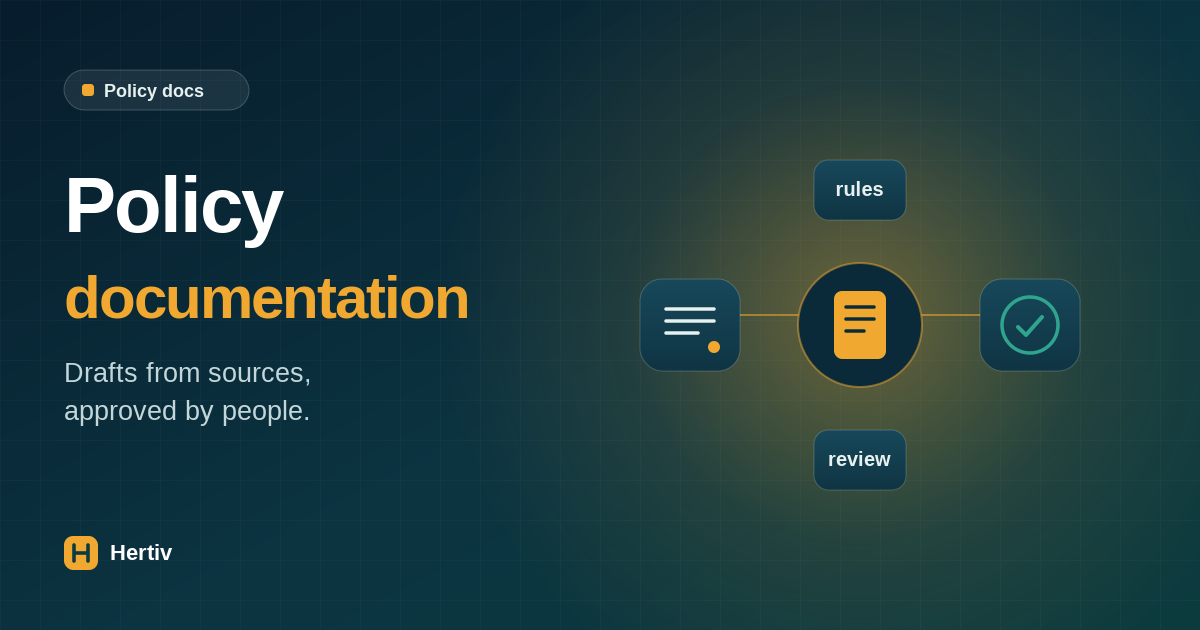
AI drafts policies from your own rules and standards, flags what it could not source, and keeps review dates in view. People still approve every rule.
On this page
Short answer
AI for policy documentation is the use of language models to draft, update and organize the policies a company runs on, from HR rules and safety procedures to data handling and standards. The AI writes a first draft from your sources, and people review, approve and own the result. It works because policies are structured and sourced from rules that already exist; it fails when a draft goes live unchecked.
What is AI for policy documentation?
AI for policy documentation is the use of language models to draft, update and organize the written policies a company runs on, from HR rules and safety procedures to data handling and security standards. The AI writes a first draft from your sources, and people review, approve and own the result.
Policies are a good fit for AI help because they are structured, repetitive and sourced from rules that already exist. A policy has a purpose, a scope, the rules themselves, who is responsible, and when it is reviewed. The AI follows that shape and fills it from your handbooks, laws and internal standards.
| Policy type | What AI drafts well | What stays human |
|---|---|---|
| HR policies | Leave, conduct, remote work rules | Final wording and approval |
| Security policies | Access, passwords, device rules | Risk decisions |
| Data policies | Retention, sharing, privacy | Legal sign-off |
| Safety procedures | Steps, checks, reporting | On-site verification |
The key point is ownership. A policy is a promise the company makes, so a person must approve it. AI can write the draft, but it cannot take responsibility for the rule. Document AI covers the wider field of AI that reads and writes business documents.
What can AI draft, and what needs a human?
AI drafts well when the source material is clear: an existing policy, a regulation, a standard or a set of decisions already made. It turns those sources into clean, consistent wording and keeps the same structure across documents.
AI struggles where judgement is needed. It cannot decide what the rule should be, whether a risk is acceptable, or how a policy should balance two competing interests. It also cannot know your company's history, such as why a rule was written a certain way after an incident.
The split is simple: AI writes, people decide. The AI produces the draft and flags anything it could not source; the owner checks the facts, makes the calls and signs off. A draft that goes live without that review is a risk, not a saving.
How does AI keep policies current?
AI keeps policies current by watching for changes in the sources a policy depends on and flagging the documents that need a review. When a regulation changes, a system updates or a new risk appears, the related policies are marked for an update instead of waiting for an annual review.
The usual pattern is a review schedule plus triggers. Each policy has a review date, and the system also watches for events: a new law, a vendor change, an incident report or a process change. Either one can start a review.
Version control matters here. Every change should record who made it, when, and why, so an auditor can trace a rule back to its source. AI can draft the change note, but the approval still comes from the policy owner.
How do teams check a policy AI drafted?
Teams check an AI-drafted policy in three passes: facts, fit and language. Facts first: every rule, date, number and reference must trace back to a source the team trusts.
Fit is second: does the policy match how the company actually works? A rule that demands a process nobody follows will be ignored, so the reviewer checks each step against the real workflow and the people who do it.
Language is third: short sentences, one rule per paragraph, no jargon the reader will not know. A policy that staff cannot understand will not be followed. The review should include someone who will actually use the policy, not only the person who wrote it. Governance teams can use AI governance guidance to set the review and approval rules for AI-written documents.
What belongs in a policy, and what does not?
A policy belongs in a document when it states a rule people must follow, who it applies to, and what happens if it is not followed. If it does not do those three things, it is probably a guide or a note, not a policy.
What does not belong: detailed how-to steps, which change often and belong in a procedure; background essays, which bury the rule; and rules nobody enforces, which teach staff that policies can be ignored.
A good test is the new starter test. If a new employee can read the policy and know what to do, it is written well. If they need a colleague to explain it, the policy needs a rewrite, and AI can help with that rewrite as long as a person checks the result.
How do you start with AI policy documentation?
You start with one policy that is out of date and has a clear owner, and you build the review habit before you scale to the whole library.
- Pick one policy. Choose one with a named owner and a known source, such as a regulation or a standard.
- Gather the sources. Collect the old policy, the regulation and the standard it must follow.
- Ask the AI to draft from those sources only. Ask it to list anything it could not source.
- Have the owner review facts, fit and language. Check every rule against its source and the real workflow.
- Approve, publish and set a review date. Record who approved it and when it is next due.
- Record the change and the sources used. Keep the audit trail so a reviewer can trace each rule.
Repeat the cycle for the next policy, and keep a list of sources the AI may use. A source list that grows with each policy is what makes the drafts more reliable over time. Data security and compliance services can help where the policy touches personal data or regulated records.
Example (hypothetical): a 300-person company updates 40 policies
Example (hypothetical): a company with 300 staff holds 40 policies, most of them two years out of date. Updating one by hand takes about 4 hours of drafting and review, so 40 policies times 4 hours gives 160 hours of work.
With AI drafting, each policy takes about 1 hour to draft and 1 hour to review, which is 2 hours each. For 40 policies that is 40 times 2 hours, or 80 hours, saving 80 hours against the manual route.
The saving is real, but only because the review step stayed in place. In the first batch, reviewers sent back 6 of the 40 drafts for missing sources, which is why the team kept the rule that no draft goes live without an owner's sign-off.
What are the common mistakes?
The most common AI policy documentation mistakes are publishing an unreviewed draft, drafting from memory instead of sources, and letting policies age without a review date.
- Publishing an unreviewed draft. AI can invent a rule that sounds right; a person must check it.
- Drafting from memory. The AI must use your sources, not its training, or the draft will drift from your rules.
- One person owning everything. Each policy needs a named owner who knows the subject.
- No review dates. Policies age quietly until an audit finds them out of date.
- Mixing policy and procedure. Steps change faster than rules; keep them in separate documents.
- Forgetting the audience. A policy written for lawyers will not be read by staff.
Key takeaways
- AI drafts policies from your sources; people decide the rules and approve them
- A draft is only as good as its sources, so keep a list of what the AI may use
- Review dates plus change triggers keep policies current between annual reviews
- Check every draft in three passes: facts, fit and language
- No draft goes live without a named owner's sign-off
Frequently asked questions
Can AI write a company policy on its own?
No. AI can draft from your sources, but a person must decide the rules, check the facts and approve the result. A policy is a promise the company makes, and only a person can take responsibility for it.
What sources should the AI use for policy drafts?
Use your existing policies, the regulations and standards they follow, and any decisions already recorded. Give the AI that list and ask it to flag anything it cannot source, rather than letting it fill gaps from general knowledge.
How often should policies be reviewed?
Most teams review each policy at least once a year, plus a review when a trigger fires: a new law, a vendor change, an incident or a process change. Record the review date in the document itself.
What is the difference between a policy and a procedure?
A policy states a rule people must follow, who it applies to and what happens if it is not followed. A procedure gives the steps for doing a task. Steps change faster than rules, so keep them in separate documents.
Can AI keep policies up to date automatically?
It can flag what needs review when a source changes, and it can draft the update. It cannot approve the change or decide that a rule is still right. Approval stays with the policy owner.
Who should own each policy?
One named person who knows the subject and can answer questions about it. Without a named owner, policies drift: nobody updates them, and nobody notices until an audit or an incident.