AI Diagnostics: What It Is and Where It Helps
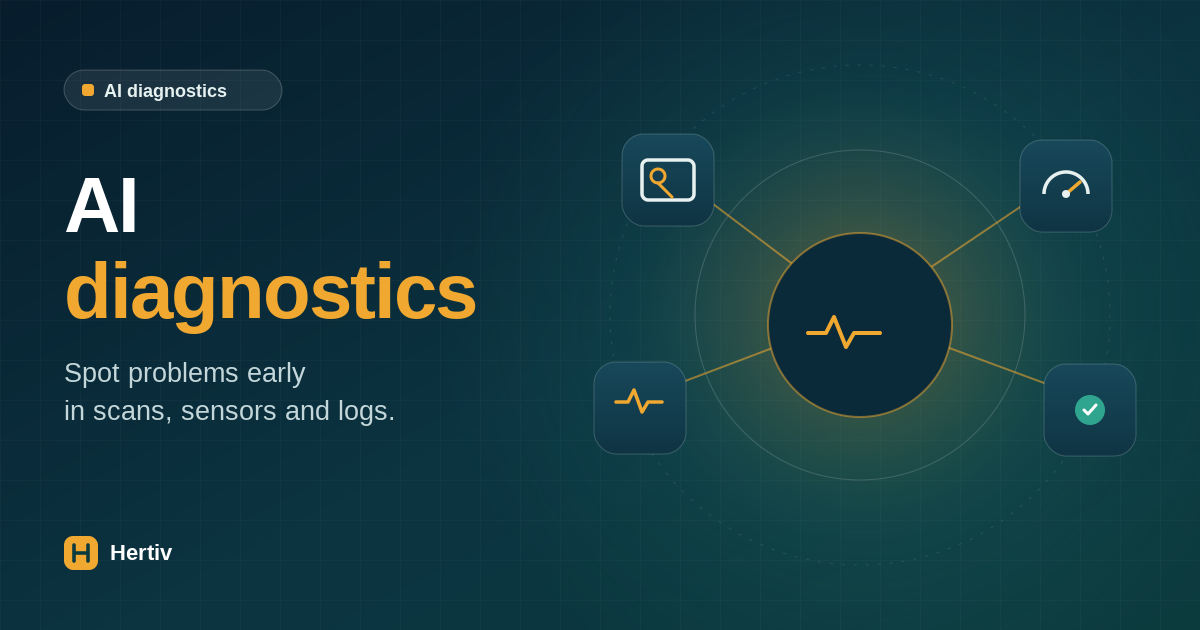
AI diagnostics uses machine learning to spot faults and disease early, from scans to sensors. Here is how it works, where it helps most, and what it cannot do.
On this page
Short answer
AI diagnostics is the use of machine learning models to detect problems — disease in a medical scan, a failing bearing in a factory, or an anomaly in a server log — earlier and more consistently than manual checks. The model compares new data with patterns learned from past cases and flags what looks wrong, while a human makes the final call.
What is AI diagnostics?
AI diagnostics is the use of machine learning models to detect a problem from data before it becomes visible to a person. The model learns what normal looks like from past examples, then flags new cases that do not match. The output is a signal, not a verdict: a person with the right training decides what to do next.
The idea is the same in every field, even though the data changes. In a hospital the input is a scan or a lab result. In a factory it is vibration, temperature and sound from a machine. In IT it is log lines and latency numbers. What the model adds is consistency: it checks every case the same way, at any hour, without getting tired.
AI diagnostics is not a single product. It is a pattern that appears inside medical imaging tools, predictive maintenance software, network monitoring and vehicle inspection systems. The quality of the result depends far more on the data it was trained on than on the model itself. That is why two tools with the same label can behave very differently on your cases.
How does AI diagnostics work?
AI diagnostics works in five steps, and each one can be checked separately. First, data is collected from the system being watched: images, sensor readings, logs or test results. Second, the data is cleaned and turned into features the model can use, such as the shape of a shadow on a scan or the frequency of a vibration.
Third, a trained model scores the new case against patterns from labelled past cases. Fourth, the score is compared with a threshold. Above the threshold the case is flagged for review; below it, it passes. Fifth, the human decision and the real outcome are recorded, and that record becomes training data for the next version.
The threshold is a business decision, not a technical one. A low threshold catches more real problems but creates more false alarms. A high threshold keeps the review queue short but misses early signs. Most teams start with a threshold that flags a manageable number of cases per day, then adjust it after a few weeks of real outcomes.
Where is AI diagnostics used?
AI diagnostics is used wherever a problem leaves a trace in data before it causes harm. The table below shows the main fields, what each one checks, and who makes the final decision.
| Field | What it checks | Typical data | Who decides |
|---|---|---|---|
| Healthcare | Signs of disease in scans | X-rays, MRIs, lab results | Doctor |
| Manufacturing | Wear in machines | Vibration, temperature, sound | Maintenance engineer |
| IT operations | Failures and intrusions | Logs, metrics, traffic | On-call engineer |
| Automotive | Faults in vehicles | Sensor and test data | Mechanic |
| Energy | Grid and turbine faults | Sensor and weather data | Grid operator |
In healthcare the model usually acts as a second reader, sorting cases so the most urgent reach a doctor first. In factories it is closer to an early warning system, because a flagged bearing can be replaced during planned downtime instead of after a breakdown.
The pattern is the same, but the cost of a missed case differs a lot, so the threshold and the review process differ too. For the medical side in detail, see AI in medical diagnosis.
What makes a diagnostic model accurate?
A diagnostic model is accurate when its training data matches the cases it will see in real use. A model trained on scans from one hospital, one machine type and one patient group will do worse on scans from anywhere else. The first question to ask a vendor is therefore not about the model, but about the data: how many cases, from how many sources, and labelled by whom.
Four things matter most:
- Label quality. Each training case needs a correct outcome, confirmed by a person who could see the result. Weak labels teach the model the wrong lesson.
- Coverage. Rare cases need to be in the training set, or the model will miss exactly the cases that matter most.
- Validation on fresh data. Test the model on cases it has never seen, from a different site or time period, before trusting it.
- Monitoring after launch. Data changes over time, so accuracy drifts. Track the flag rate and the share of flags that turn out to be real.
Accuracy is also a matter of definition. A model that is right 95% of the time can still be useless if the 5% it misses are the dangerous cases. Ask for the miss rate on serious cases specifically, not just an overall score.
What can AI diagnostics not do?
AI diagnostics cannot explain why a case is unusual, and it cannot take responsibility for the decision. It can point at a region of a scan or a sensor reading that looks odd, but it cannot say whether the oddity matters, what caused it, or what to do about it. That judgement stays with a person.
It also cannot work where the data is thin or biased. If a condition is rare, if the training cases all come from one group of people or one type of machine, or if the labels were collected carelessly, the model will fail quietly. It will still produce a score, and that score will look confident. This is the most dangerous failure mode, because nothing in the output says the model is guessing.
There are also hard limits on privacy and regulation. Medical diagnosis models are regulated as medical devices in many countries, and patient data cannot be used for training without a legal basis. In industrial settings, sensor data may reveal production details a company does not want to share. Plan for the data rules before you plan the model, and check the security side in AI security before connecting a diagnostic tool to live systems.
How do you start with AI diagnostics?
You start with AI diagnostics by picking one narrow problem with a clear outcome, then proving the model helps on real cases before you expand. A workable sequence:
- Pick one problem. Choose a case type where a missed problem is costly and where a human already reviews the data. Avoid starting with the hardest cases.
- Gather labelled cases. Collect at least a few hundred past cases with known outcomes, including the rare and difficult ones.
- Run a silent trial. Let the model score live cases for a few weeks without acting on the scores, and compare them with the human decisions.
- Set the threshold and the review rule. Decide who reviews flagged cases, how fast, and what happens when the model and the human disagree.
- Go live with a human in the loop. Keep the human decision as the final step, and log every flag, decision and outcome.
- Review monthly. Check the miss rate, the false alarm rate and whether the data has changed, and retrain when it has.
The silent trial is the step most teams skip, and the one that saves the most trouble. It shows you the real false alarm rate on your data before anyone has to act on it. For factory equipment the same pattern applies, and AI in predictive maintenance covers the maintenance side in more detail.
Example (hypothetical): a factory adds AI diagnostics
Example (hypothetical): a plant runs 60 pumps, each checked by hand once a week. In one year, 24 bearing failures occurred, and the weekly hand checks caught 9 of them before a breakdown. The other 15 stopped the line without warning.
The plant adds vibration sensors and a diagnostic model. Over the next year, again 24 bearing failures occur. This time the model flags 21 of them at least a week before breakdown, and 3 are missed. The model raises 30 flags in total: 21 real problems and 9 false alarms. The maintenance team inspects each flag, which takes about an hour per flag, so 30 hours of inspection replaces the 15 unplanned stoppages.
The result is not that the model is perfect. It still misses 3 failures and wastes 9 hours on false alarms. The gain is that 21 failures move from unplanned stoppages to planned repairs, and the team can see the miss rate and the false alarm rate in plain numbers. That is what makes the next decision easy: keep the model, and spend the effort on the 3 missed cases.
What are the common mistakes?
The most common AI diagnostics mistakes are trusting a vendor score, skipping the silent trial, and letting the model decide without a human. All three are easy to avoid once you know to look for them.
- Trusting an overall accuracy number. Ask for the miss rate on serious cases and the false alarm rate on your own data.
- Training on one site only. A model trained on one hospital or one machine type will disappoint everywhere else.
- Skipping the silent trial. Without it you learn the false alarm rate from angry reviewers instead of from data.
- No owner for flagged cases. A flag that nobody reviews is worse than no flag, because it creates a false sense of safety.
- Never retraining. Machines age, patients change, software updates. A model that is never retrained quietly gets worse.
- Treating the score as a diagnosis. The model flags; the person diagnoses. Blurring that line is how errors reach patients and production.
Key takeaways
- AI diagnostics flags problems early; a human still makes the final decision
- The same pattern works in healthcare, factories, IT and energy, with different data
- Accuracy depends on label quality and coverage, not on the model name
- A silent trial shows the real false alarm rate before anyone acts on a flag
- Track the miss rate on serious cases and retrain when the data changes
Frequently asked questions
What is AI diagnostics in simple terms?
AI diagnostics is software that learns what normal data looks like, then flags new cases that do not match. It is used to spot disease in scans, wear in machines and anomalies in IT systems. The model produces a signal, and a trained person decides what to do with it.
Is AI diagnostics the same as predictive maintenance?
No. Predictive maintenance is one use of AI diagnostics, applied to machines. AI diagnostics is the broader pattern, which also covers medical scans, vehicle faults, network anomalies and energy systems. The method is similar, but the data and the decision-maker differ.
How accurate is AI diagnostics?
It depends on the data, not on the tool name. A model trained on many labelled cases from several sites can catch most real problems, but it will still miss some and raise false alarms. Ask for the miss rate on serious cases and the false alarm rate on your own data before trusting it.
Can AI diagnostics replace doctors or engineers?
No. A diagnostic model cannot explain why a case is unusual or take responsibility for a decision. In healthcare it usually acts as a second reader, and in industry as an early warning system. The human stays in the loop for the final call.
What data do you need to start?
You need past cases with known outcomes, including the rare and difficult ones, and the labels must be correct. A few hundred cases are usually enough for a first trial. If the labels are weak or all from one site, fix that before buying a model.
How do you know if a diagnostic model is getting worse?
Track the flag rate, the share of flags that turn out to be real, and the miss rate on serious cases each month. If the numbers move, check whether the data has changed, then retrain. A model that is never checked quietly gets worse as machines age and data shifts.