How to Choose an AI Development Company in California
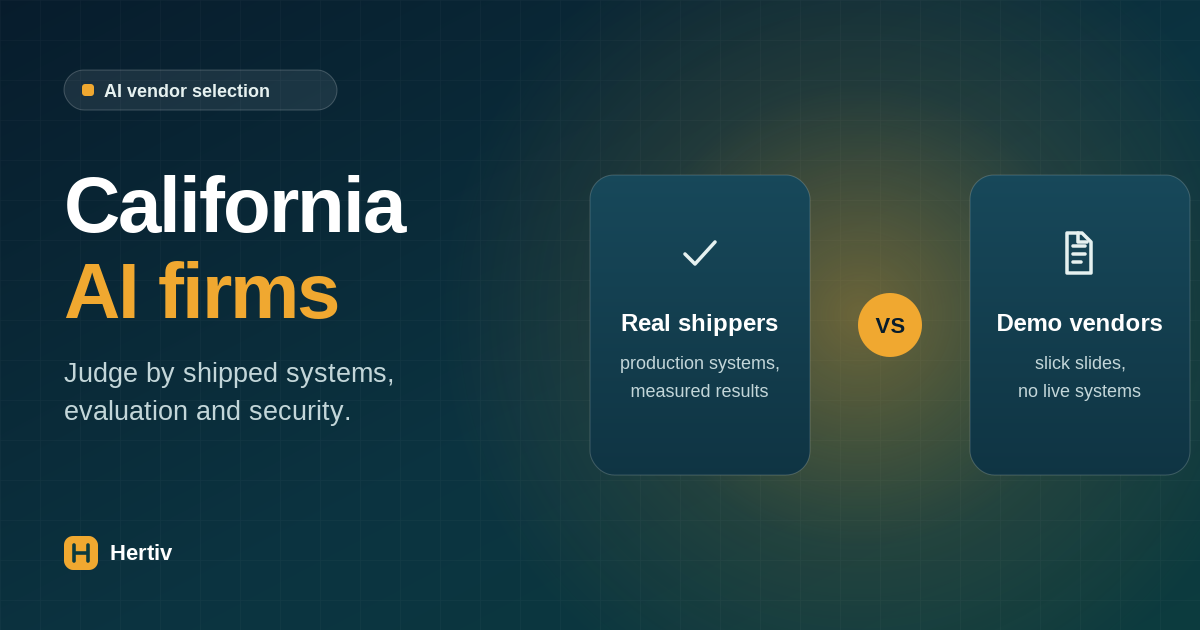
California has many AI development firms. Judge them by shipped production systems, evaluation discipline, security and clear ownership, not by model demos or office size.
On this page
Short answer
Choose an AI development company in California by checking production references, how it evaluates model quality, its data security and IP terms, and whether it hands over code and documentation. Favour firms that show working systems and clear scope over those that lead with model names or headcount.
What does an AI development company in California actually do?
An AI development company designs, builds and operates software that uses models, data and integrations to automate or assist real work. In California the market splits into large consultancies, product studios, specialist agent and RAG firms, and staff augmentation shops.
The work usually covers some mix of:
- Discovery and scoping: mapping a workflow, data sources and success measures.
- Data engineering: pipelines, retrieval indexes, labelling and quality checks.
- Model work: prompting, retrieval-augmented generation, fine-tuning or a mix.
- Application build: APIs, user interfaces, copilots, chat and voice channels.
- Operations: monitoring, evaluation, cost control and incident response.
California's concentration of AI talent and venture-backed startups means many firms have strong model expertise. It also means a lot of noise: companies that build impressive demos but have never run a system under real load, with real users and real compliance constraints. The rest of this article is about separating those two groups.
If you want a structured question list, see how to choose an AI development company.
What should you check before shortlisting firms?
Start with the problem, not the vendor list. A clear internal brief narrows the field faster than any comparison spreadsheet.
Write down:
- The workflow you want to change, with the current steps, people and systems involved.
- The outcome measure, such as handling time, resolution rate, error rate or revenue per rep. It must be observable.
- The data you can legally use, where it lives and who owns it.
- Constraints: latency, on-premise or cloud, data residency in the US or EU, integration limits.
- Budget shape: a fixed proof of concept first, then a build phase, then run costs.
With that brief you can filter quickly. Firms that ask sharp questions about data and failure modes are usually stronger than those that immediately propose a model and a timeline. Ask each shortlisted firm to describe a similar workflow they have shipped, and ask what broke in production.
Which capabilities matter most in an AI build?
The most useful capability is engineering discipline around models, not access to a particular model. Models change quickly; evaluation, data handling and integration work is what keeps a system reliable.
Look for evidence of:
- Evaluation: test sets, regression checks and acceptance thresholds agreed before build.
- Retrieval and grounding: retrieval-augmented generation patterns so answers cite your documents rather than invent facts. See RAG development.
- Agent design: tool calling, permissions, human approval steps and guardrails for anything that takes action. See agentic AI development.
- Integrations: connectors to your CRM, ERP, ticketing or data warehouse, and secure tool access where needed.
- Operations: logging, cost tracking, drift monitoring and a rollback plan.
- Product engineering: if the output is a product for your customers, UI, auth, billing and release process matter as much as the model.
A firm that can explain how it measures quality, and what it does when quality drops, is usually the better partner.
How do you compare California firms fairly?
Use the same scorecard for every firm so the comparison is about substance, not presentation.
| Criterion | What good looks like | What to watch for |
|---|---|---|
| Production references | Named systems in use, with owners you can call | Demos only, or references who cannot discuss outcomes |
| Evaluation practice | Test sets and acceptance criteria defined up front | Quality judged by "it looks good" |
| Data and security | Written data handling, residency and access controls | Vague answers about where data goes |
| Ownership | Code, prompts and models handed over | Lock-in to the vendor's platform |
| Team shape | Small senior team with domain depth | Large bench with junior rotation |
| Scope discipline | Phased plan with a paid proof of concept | One big fixed-price promise |
| Cost transparency | Build cost plus expected run costs | Model and inference costs left unmentioned |
Score each firm on the same rows, and weight the rows that match your risk. A regulated finance or health workflow should weight security and evaluation far above speed of delivery.
What contract and ownership terms should you insist on?
Insist on owning the code, prompts, configuration and any fine-tuned artefacts your money paid for. Ambiguity here is expensive to fix later.
Key terms to settle in writing:
- IP assignment: source code, prompts, evaluation sets and derived models transfer to you on payment.
- Data use: your data is not used to train vendor or third-party models beyond your scope, and is deleted on request.
- Model dependencies: which providers are used, what happens if a model is deprecated, and how switching is handled.
- Security: access controls, logging, incident notification and, where relevant, data residency in the US, UK or EU.
- Acceptance: measurable criteria tied to the evaluation set, not to a subjective sign-off.
- Exit: documentation, runbooks and a handover period so another team can take over.
What is a realistic first engagement?
A paid, time-boxed proof of concept is the standard first step, and it should test the riskiest assumption rather than the easiest feature. If retrieval quality is the unknown, test that. If user adoption is the unknown, put a thin interface in front of real users.
A practical shape:
- Two to three weeks of discovery, producing a workflow map, data inventory and evaluation plan.
- Four to six weeks of build, delivering a working system on real data with a measured result against the agreed criteria.
- A decision point: proceed to production build, adjust scope, or stop.
Expect proof-of-concept costs to vary widely with scope, integration count and data quality; treat any figure as a typical range that depends on the brief. Production builds cost more than the pilot because security, monitoring and integration work expands. Ask for an estimate of ongoing inference and infrastructure costs alongside the build price.
Hertiv runs a fixed-shape AI proof of concept in four weeks as one model for this stage.
How to prioritise and run the selection
Run a short, disciplined process rather than a long beauty parade.
- Shortlist four to six firms that have shipped in your domain or a close one, mixing specialist AI firms and product studios.
- Send the same brief and a short paid or unpaid technical exercise, such as a design for your evaluation approach.
- Interview the actual delivery team, not only sales, and ask what failed in past projects.
- Check two references with people who own the system day to day.
- Start with a proof of concept with written success criteria and an explicit stop option.
Avoid choosing on brand or office location alone. A California address tells you little about delivery quality; the team, the references and the evaluation discipline do.
Common mistakes when hiring AI developers
Most failures come from scoping and governance, not from model choice.
- Buying a demo. A polished chat window proves little about accuracy, latency or cost at volume.
- No evaluation set. Without agreed tests, nobody can say whether the system works.
- Ignoring run costs. Inference and infrastructure bills can outgrow the build cost if usage is unmanaged.
- Skipping security review. Data flow, access and logging need review before build, not after.
- Vague ownership. Prompts and evaluation data are assets; make sure they transfer.
- One giant phase. Long fixed-price builds hide risk; shorter phases surface it early.
- No human fallback. For any action-taking agent, plan for review and override.
Key takeaways
- Ask for production systems with measurable outcomes, not slide decks or demo videos.
- Check whether they define evaluation sets and acceptance criteria before building.
- Confirm who owns code, prompts, datasets and fine-tuned models at the end.
- Verify data handling, residency and security practices in writing.
- Prefer a small senior team with domain depth over a large generalist bench.
- Agree a paid, time-boxed proof of concept with explicit success criteria.
Frequently asked questions
How much does it cost to hire an AI development company in California?
Costs vary widely with scope. A focused proof of concept is typically a smaller fixed engagement, while production builds add integration, security and monitoring work. California rates tend to be higher than many other regions. Always ask for build cost plus expected ongoing inference and infrastructure costs.
Should I choose a California firm or an offshore team?
Choose on capability and fit, not location. California firms often bring strong model and product experience and easier time-zone overlap; offshore teams can cost less but need stronger specification and oversight. A mixed model with a local lead and a larger remote build team is common.
What should a first AI project deliver?
A working system on real data, measured against agreed criteria, plus documentation and a clear recommendation on whether to proceed. The goal is to reduce uncertainty about quality, cost and adoption, not to ship every planned feature.
How do I evaluate an AI vendor's technical claims?
Ask for a concrete walkthrough of a past system: the data flow, how quality was measured, what failed and what changed. Request references who operate the system. Vague answers about evaluation and monitoring are a stronger signal than any list of model names.
Who owns the AI models and code after the project?
You should own the application code, prompts, configuration and any fine-tuned artefacts produced for you. Base model weights are usually licensed from a provider, not owned. Put the assignment in the contract and confirm you can operate the system without the vendor.
How long does an AI proof of concept take?
A narrow proof of concept usually takes four to eight weeks including a short discovery phase. The timeline depends on data access, integration count and how clearly success is defined. Longer than that usually means the scope is too broad for a pilot.


