AI Deep Learning Applications: Where They Work Best
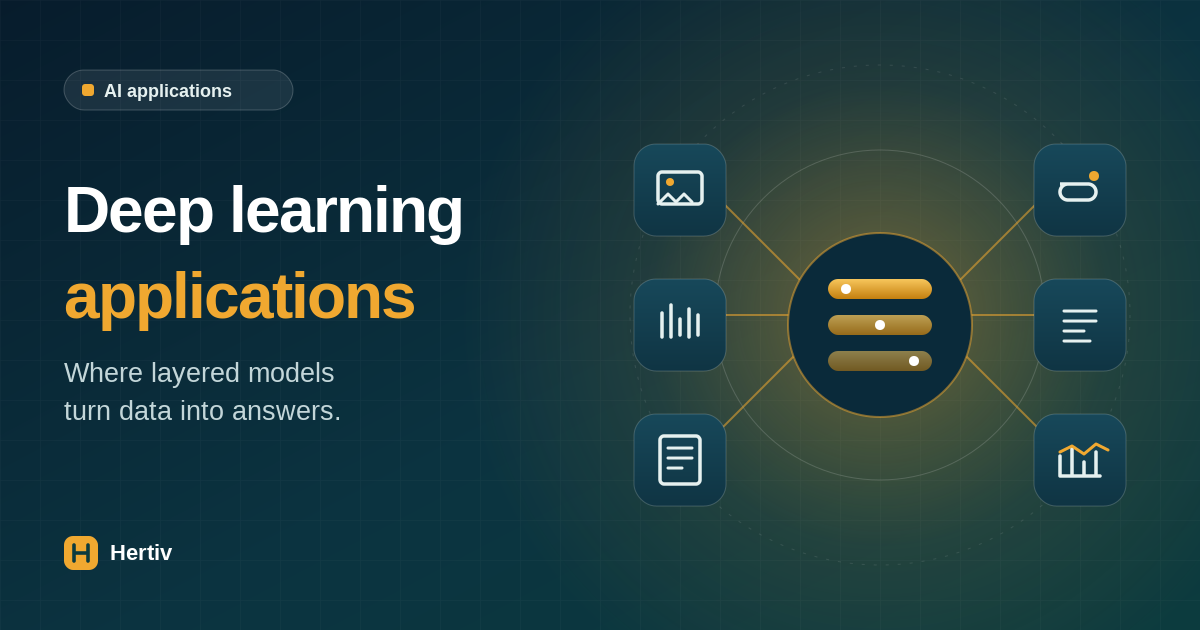
Deep learning works best where large labelled datasets meet clear patterns: vision, speech, language and forecasting. Here is where each application fits.
On this page
Short answer
Deep learning applications are the tasks where layered neural networks turn large amounts of data into useful output: recognising objects in photos, transcribing speech, sorting documents, answering questions and forecasting demand. They work best where examples are plentiful and the right answer is clear, and they need labelled data, a test set and human review for high-stakes decisions.
What is deep learning, and where is it applied?
Deep learning is a form of machine learning that uses layered neural networks to find patterns in large amounts of data, and its applications are the tasks where those patterns turn into useful output, such as reading images, transcribing speech, sorting documents and forecasting demand.
Every application follows the same pattern. The model learns from many labelled examples, then scores new input the same way. That is why deep learning fits tasks with plenty of examples and a clear right answer, and struggles where examples are rare or the goal is vague.
| Application area | What it does | What it needs | Where it fits |
|---|---|---|---|
| Image and video | Recognises objects, faces and defects in photos and video | Labelled images and video | Quality checks, claim photos |
| Speech and audio | Turns speech into text and flags tone or keywords | Recorded calls with transcripts | Call summaries, voice agents |
| Language and text | Summarises, classifies and answers from documents | Contracts, emails, tickets | Document search, drafting |
| Forecasting and decisions | Predicts demand, risk and failures from history | Past orders, sensor readings, claims | Stock planning, fraud checks |
The table is a shortlist, not a promise. Each row only works when the data behind it is clean and the team has a way to check the output. For the mechanics behind the models, see what deep learning is.
How does deep learning help with images and video?
Deep learning helps with images and video by recognising what is in a frame: objects, people, text, damage or defects, and it does this at a scale no review team can match, checking thousands of images while a person checks a handful.
On a production line, a camera can spot a cracked part or a missing label as items pass, and the line stops only for the items that fail the check. In a warehouse, the same idea counts stock on shelves from photos. In insurance, a model can read claim photos and sort them by damage type before a handler opens the file.
The work starts with labelled images: photos where a person has marked what is in each one. A model trained only on daylight photos may fail at night, and one trained on one product may fail on the next. Keep a human review step for the cases the model flags as uncertain. For teams building this, computer vision development covers the camera, model and review loop together.
What can deep learning do with speech and audio?
Deep learning can turn speech into text, summarise a call, spot keywords and flag calls that need a human, which makes it useful anywhere a team already records conversations and reads them back later.
In a support centre, calls are transcribed as they happen, then summarised into the few lines a handler needs: what the customer asked, what was agreed and what is still open. The model can also flag calls where a customer sounds frustrated or where a compliance phrase was missed, so a team lead reviews those first instead of sampling at random.
Voice assistants and meeting notes use the same building blocks. The limits are practical: accents, background noise and overlapping speakers all raise the error rate, and recordings need consent and clear storage rules. Test on your own calls, not on a vendor demo, before you trust the output.
How is deep learning used in language and documents?
Deep learning is used in language and documents to classify text, pull out key fields, summarise long files and answer questions from a set of documents, which suits any team that spends its day reading and retyping.
A support team can route tickets by topic before a person reads them. A legal team can search contracts for a clause across thousands of files. A finance team can pull invoice numbers, dates and totals from PDFs into its system. In each case the model does the reading, and a person checks the result.
The risk is confident wrong answers. A model can produce a smooth summary that cites a clause that does not exist, so retrieval plus citations matters: the answer should point at the source text. Keep the source documents clean, because the model can only be as accurate as what it reads. See document AI for the extraction and validation pattern.
Where does deep learning help with forecasts and decisions?
Deep learning helps with forecasts and decisions by finding patterns in past records and projecting them forward, which fits demand planning, equipment care, fraud checks and any ranking task where history repeats itself.
A retailer can forecast how much of each product each depot needs next week. A factory can predict which machines are likely to fail from sensor readings. A bank can flag transactions that look unlike a customer's normal pattern. In each case the output is a ranked list or a range, not a single certain number.
Check forecasts against what really happened, and the gap is what improves the model. A forecast that said 100 cases and sold 140 is useful only if the team asks why. For the boundary between the two approaches, see deep learning vs machine learning.
For building the system itself, machine learning development covers the data, model and review loop together.
Example (hypothetical): a retailer checks shelves with a camera
Example (hypothetical): a grocery chain fits cameras above shelves in 40 stores to spot empty shelves and wrong prices. Each camera takes a photo every 30 minutes during opening hours, and the model flags the shelves that need a visit.
The arithmetic is simple. The chain is open 12 hours a day, so each store produces 24 photos a day and all 40 stores produce 960 photos a day. A person checking each photo would take about 2 minutes, so 960 photos take 1,920 minutes, or 32 hours a day.
The model flags about 60 shelves a day, and a staff member checks each flagged shelf in about 5 minutes, so 60 checks take 300 minutes, or 5 hours a day. The team saves about 27 hours a day of photo review and catches empty shelves the same day instead of at the next walk-through.
The pilot started in 4 stores with 200 labelled photos of each shelf state. Only after the model flagged the right shelves in 9 of 10 test photos did the chain roll it out to the other 36 stores.
What are the common mistakes?
The most common deep learning mistakes are starting without labelled data, expecting the model to work on data it never saw, and skipping the human review step on high-stakes decisions.
- No labelled test set. Without fresh examples with known right answers, you cannot tell whether the model works.
- Training on one setting, deploying in another. A model trained on clean studio photos fails on blurry phone photos.
- Trusting the output blindly. High-stakes decisions need a person to check the result before it reaches a customer.
- Measuring accuracy on training data. A model can memorise its training set and still fail on new input.
- Buying a model before fixing the data. Messy, duplicated or out-of-date records produce messy output.
Key takeaways
- Deep learning fits tasks with plenty of labelled examples and a clear right answer
- Vision, speech, language and forecasting are the four areas where it works best
- Labelled data matters more than model choice
- Predictions are ranges, not certainties, so check them against real outcomes
- Keep a human in the loop for high-stakes decisions
Frequently asked questions
What is the difference between deep learning and machine learning?
Deep learning is a form of machine learning that uses layered neural networks, while machine learning also covers simpler methods such as decision trees and linear models. Deep learning suits large, messy datasets such as images and text, while simpler methods often work better on small, structured tables.
How much labelled data does deep learning need?
It depends on the task, but a narrow job such as sorting photos into five categories often needs hundreds to thousands of labelled examples per category. Start with a small labelled test set, measure the model on it, and add labels where the model fails most.
Can deep learning work with small datasets?
Usually not well on its own. A common fix is transfer learning: start from a model trained on a large public dataset and fine-tune it on your own examples. This works well for images and text, but it still needs a labelled test set to prove the result.
Does deep learning replace human experts?
No. It ranks, flags and drafts, and people decide. A model can sort a thousand claim photos in minutes, but a handler still decides the payout. The best setups use the model to remove routine reading and leave judgement to people.
What hardware does deep learning need?
Training a model from scratch usually needs graphics processors and takes hours or days, while running a trained model often needs far less and can run on ordinary servers or even on a device. Most teams train in the cloud and run the finished model where the data already lives.
How do you know if a deep learning model is good enough?
Test it on fresh labelled examples it has never seen and compare the result with the current manual process. Track the error rate on that fixed test set over time, so each change is judged on the same cases instead of on anecdotes.


