AI Consulting vs AI Development vs Staff Augmentation
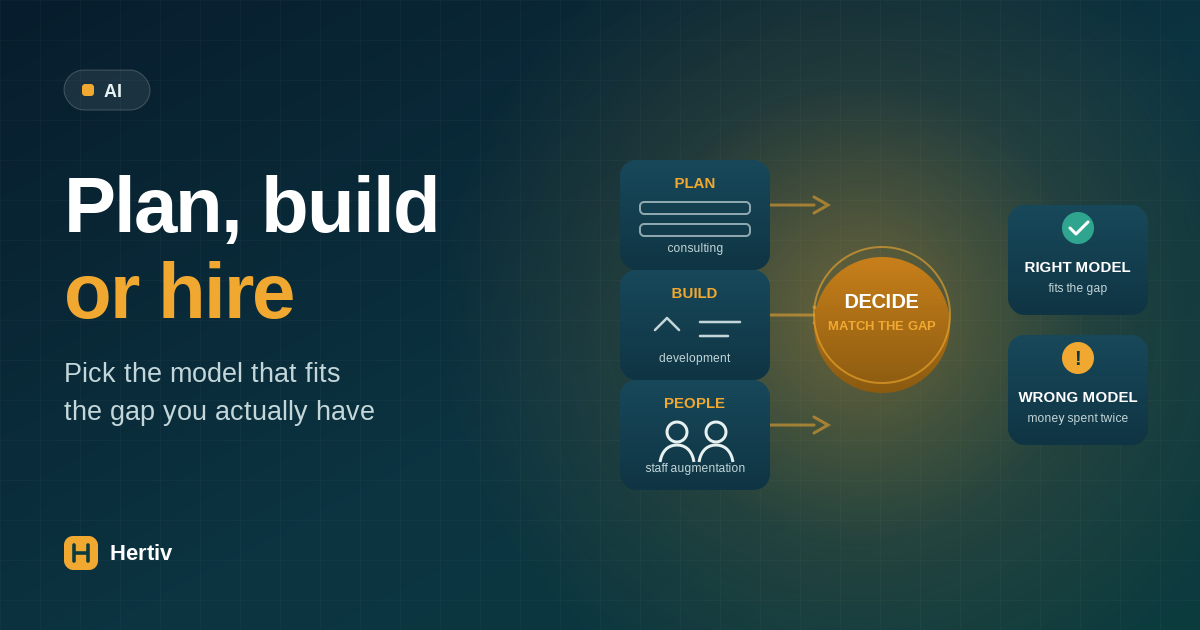
Consulting gives a plan, development gives a product, and staff augmentation gives people. Pick by whether you need direction, delivery or extra hands.
On this page
Short answer
AI consulting, AI development and staff augmentation solve different problems: consulting gives a team a plan and a decision, development delivers a working product, and staff augmentation adds skilled people to a team that already exists. Choosing the wrong model wastes money, because each one assumes a different starting point.
What do these three models actually mean?
AI consulting is advice and planning: a specialist team studies the business, finds where AI can help, and delivers a plan with costs, risks and a recommended first step. AI development is building: a team designs, builds and ships a working AI product or feature. Staff augmentation is hiring extra people: engineers or data specialists join the client's team for a set period and work under the client's direction.
The difference is who owns what. With consulting, the client owns the decision and the plan; the consultant does not build the product. With development, the provider owns delivery and is judged on a working product. With staff augmentation, the client owns the plan and the delivery; the provider supplies people with the right skills. For the consulting side, AI consulting covers how a plan is put together and what it should contain.
Mixing the models up causes the most common failures. A team that hires augmented staff without a plan gets busy people with no direction, while a team that buys a full build before knowing what it needs gets a product nobody asked for. The model should match the gap, not the fashion.
How do the three models compare?
The three models differ in what you receive, who manages the work, how fast you start, and what happens when the work ends.
| AI consulting | AI development | Staff augmentation | |
|---|---|---|---|
| What you get | A plan and a decision | A working product | Extra skilled people |
| Who manages | Client, with advice | Provider team | Client team |
| Time to start | Days to weeks | Weeks to set up | Days to weeks |
| Best when | Direction is unclear | A product must ship | Team is short-handed |
| What remains after | Plan and priorities | Product and docs | Knowledge in the team |
Cost follows the same pattern. Consulting is usually the smallest spend, since it is a fixed piece of work with a clear end. Development is the largest, since it covers design, build, testing and launch.
Staff augmentation sits in the middle: the cost is the time of the people supplied, and it stops when they leave. The cheapest model is the one that fits the gap; the most expensive is the one that has to be redone.
Risk also differs. Consulting risks a plan that is never used, development risks a product that misses the need, and staff augmentation risks people who do not fit the team. Each risk is managed differently, which is why the choice should be made deliberately rather than by habit.
When does AI consulting fit?
AI consulting fits when the team does not yet know where AI helps, what it costs, or which use case should come first.
A consulting engagement usually starts with interviews and a look at the data and the workflows, then ranks the use cases by value and effort. The output is a short list of use cases, a plan for the first one, and the costs and risks attached to each. That plan is the point: it gives a leadership team something to approve or reject, rather than a vague ambition.
Consulting also fits before a large spend. A team planning a six-figure build should spend a small share of that budget on a plan first, because the plan can catch a bad idea early, when it is cheap to stop. The guide to AI consulting companies explains what to look for when choosing a consulting partner.
The limit is that consulting does not build anything. A team that already knows what it needs does not need more advice; it needs people or a build. Buying consulting when the decision is already made is a delay, not a step forward.
When does AI development fit?
AI development fits when the team knows what to build and needs a working product, with a provider responsible for delivering it.
A development engagement starts from a defined scope: the use case, the data, the users and the success measure. The provider designs the product, builds it, tests it and ships it, and the client judges the result. This model suits teams that have a clear need but no in-house AI team, or an in-house team that is busy with other work.
Development works best with a small first version. A proof of concept that tests one workflow with real data gives the team something real to judge, and the lessons from it shape the full build. A large build without that step is a bet, not a plan.
The limit is control. The provider owns the build, so the client must be clear about the scope, the data and the acceptance tests. Without those, the product can drift from the need, and the client may only notice at the end.
When does staff augmentation fit?
Staff augmentation fits when the team already has a plan and a product direction, but is short of the people to build it.
Augmented engineers, data scientists or ML specialists join the client's team, work in its tools and follow its processes. The client keeps control of priorities and delivery, and the added people fill specific gaps, such as model tuning, data pipelines or front-end work. For the basics, what staff augmentation is explains how the model works and when it is used.
This model fits best when the gap is known and temporary. A team building a product over six months may need two extra engineers for that period, then return to its normal size. It also fits when the team wants to keep knowledge in-house, since the augmented staff work alongside the client's people and the knowledge stays after they leave.
The limit is management. The client must have someone to direct the added people, review their work and set priorities. Without that, augmented staff sit idle or build the wrong thing, and the cost runs with no result. A team with no one to manage the work should choose development instead, where the provider manages delivery.
Example: a retailer choosing between the three
Example (hypothetical): a retailer with 40 stores wants to use AI to cut the time its support team spends answering the same product questions.
The retailer starts with consulting. A two-week engagement costs 10,000 dollars and finds that a support assistant could handle the most common questions, that the product data is clean enough, and that the first version should cover only the top 20 questions. The plan also sets a target: cut first-response time from 4 hours to 30 minutes.
The retailer then buys development. A 12-week build costs 90,000 dollars and delivers a working assistant that answers the top 20 questions, with a human handover when it cannot help. The build is the largest spend, since 90,000 is nine times the 10,000 spent on consulting, but it is also the part that produces a product.
After launch, the retailer adds one augmented engineer for 8 weeks at 5,000 dollars a week, which is 40,000 dollars, to connect the assistant to the returns system. The total is 140,000 dollars, since 10,000 plus 90,000 plus 40,000 is 140,000. Each model was used for the gap it fits: consulting for the decision, development for the product, augmentation for the extra work.
What are the common mistakes?
The most common mistakes are buying the wrong model for the gap, skipping the plan, and hiring people with no one to manage them.
- Buying a build before a plan. A product built on an untested idea is expensive to fix. Spend a small share on a plan first when the direction is unclear.
- Buying consulting when the decision is made. If the team already knows what to build, more advice is a delay. Move to development or augmentation instead.
- Augmenting without management. Added people need direction, review and priorities. Without a manager on the client side, the cost runs with no result.
- Judging by price alone. The cheapest model is the one that fits. A cheap build that misses the need costs more than a plan that catches the mistake early.
- No handover plan. When the engagement ends, the client should own the docs, the code and the knowledge. Agree the handover before the work starts, not at the end.
Key takeaways
- Consulting gives a plan, development gives a product, augmentation gives people
- The model should match the gap: unclear direction, a product to ship, or a short-handed team
- Consulting is the smallest spend and the best way to test an idea before a large build
- Staff augmentation only works when the client has someone to direct the added people
- Agree the handover — docs, code and knowledge — before the work starts
Frequently asked questions
What is the difference between AI consulting and AI development?
AI consulting delivers a plan: which use cases to build, in what order, at what cost and with what risks. AI development delivers a working product built to that plan or to a defined scope. Consulting ends with a decision, while development ends with software the team can use.
Is staff augmentation the same as outsourcing?
No. With staff augmentation, extra specialists join the client's team and work under the client's direction, using the client's tools and processes. With outsourcing, the provider takes on a whole piece of work and manages delivery itself. The difference is who manages the people and the priorities.
Can I combine all three models?
Yes, and many teams do. A common sequence is consulting for the plan, development for the first product, and staff augmentation for later work the in-house team cannot cover. The key is to use each model for the gap it fits, rather than buying all three at once.
Which model is cheapest?
Consulting is usually the smallest single spend, development the largest, and staff augmentation in the middle. But the cheapest model is the one that fits the gap. A cheap build that misses the need, or augmented staff with no direction, costs more than the right model bought first.
How long does an AI consulting engagement take?
A focused engagement usually takes two to four weeks, covering interviews, a look at the data and workflows, and a ranked plan. Larger engagements that cover several business units take longer, but the first usable plan should arrive early rather than at the end.
What should I ask before choosing a model?
Ask what the gap is: direction, delivery or people. Then ask who will manage the work, what will remain when the engagement ends, and how success will be measured. The answers point to the model, and they also make the agreement clearer for both sides.


