How to Interview an AI Company Before You Sign
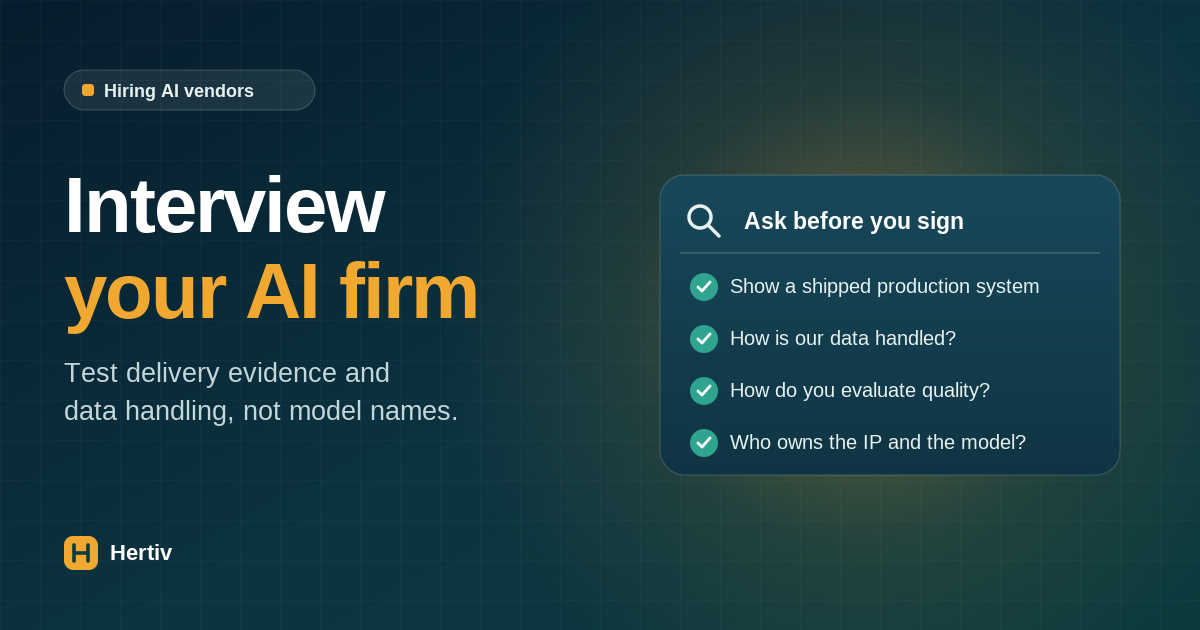
An AI company interview should test delivery evidence, data handling and evaluation, not model names. Ask for past work, security practices and how success is measured.
On this page
Short answer
An AI company interview should test how the vendor scopes problems, evaluates model quality, handles your data and supports the system after launch, using past work as evidence. Model names and demo polish matter far less than clear delivery process, security practice and measurable acceptance criteria.
What is an AI company interview and what should it cover
An AI company interview is a structured evaluation of a vendor's ability to design, build and operate AI systems for your organisation. It differs from a standard software vendor interview because AI systems fail in ways ordinary software does not: outputs are probabilistic, quality drifts when models change, and data handling carries extra legal risk.
A useful interview covers five areas:
- Delivery evidence. Past systems in production, with the trade-offs they made.
- Problem framing. Whether they separate a model problem from a workflow or data problem.
- Evaluation. How they define and measure quality before and after launch.
- Data and security. Where data goes, how long it is kept and who can see it.
- Ownership and support. What you control after go-live and who maintains it.
Most weak interviews focus on which model or framework the vendor uses. That detail changes every few months. The five areas above are what determine whether the system still works a year later. If you want a more detailed question set, Hertiv publishes a separate list in how to choose an AI development company.
Treat the interview as two-way. Good vendors will push back on vague goals, which is a signal that they have done this before.
Which questions reveal real delivery experience
Ask for one recent project and walk through it chronologically. Strong vendors describe what broke, what they cut and why. Weak ones describe only the outcome.
Questions that separate the two:
- What was the business metric, and how did you measure it? Look for a defined metric such as deflection rate, time per case or error rate, not "user satisfaction".
- What did the first version get wrong? A vendor who cannot name a failure either did not build it or did not stay long enough to see it.
- What did you decide not to build? Scope discipline shows in what was cut.
- Who wrote the evaluation set, and how large was it? This is the single most revealing AI question. If there is no evaluation set, quality was never measured.
- What happened when the model provider changed something? Systems in production get affected by upstream updates. Ask how they detected and handled it.
- Who is on support now? Ask whether the original engineers remain involved.
Example: a vendor says a support assistant reduced ticket volume. Ask how many tickets were in scope, how the assistant handed off to humans, and what happened to the ones it got wrong. If the answer is vague, the metric is probably not theirs.
How to test their approach to data, security and compliance
Ask directly where your data goes and who can access it. Vague answers here are a reason to stop the process.
Cover these points:
- Model hosting. Is inference through a hosted API, a private deployment or your own cloud tenant? Each has different data exposure.
- Training use. Will your data be used to train or fine-tune models, theirs or a provider's? Get this in writing.
- Retention. How long are prompts, documents and outputs stored, and can you set deletion?
- Access control. Which of their staff can see production data, and is access logged?
- Residency. Where is data stored and processed? This matters for EU and Middle East buyers with local rules.
- Personal data. How do they handle PII in prompts, and can they redact before sending to a model?
- Incident process. Who do you call if data leaks or an agent takes a wrong action?
For agents that take actions, add questions about permissions and human approval steps. An agent with write access to a finance or CRM system needs guardrails designed before launch, not after. Hertiv's AI security page describes the controls worth requiring.
How do you evaluate quality and define success before build
Require a written evaluation plan before any build starts. Without one, "the AI is good" becomes an argument you cannot win.
A workable plan has four parts:
- A task definition. Exactly what the system does, with examples of correct and incorrect output.
- An evaluation set. A sample of real cases, labelled by your team, that the vendor tests against repeatedly. Even a small set is better than none.
- Metrics that match the task. Exact match for extraction, human review scores for drafting, task completion for agents. Accuracy alone is often the wrong metric.
- A gate for launch. A threshold agreed in advance, plus a plan for what happens below it.
Ask how they handle the long tail: edge cases, ambiguous inputs and requests outside scope. Good systems say "I do not know" or hand off to a person. Ask how often that happens and whether it is measured.
Also ask about cost per interaction. Token and API costs can grow quietly with usage. A vendor should be able to explain how they keep cost predictable and where they would cache or route to a cheaper model. For a short pilot, an AI proof of concept in four weeks is often the cleanest way to test these claims before a larger commitment.
What should you ask about ownership, handover and cost
Ask what you own on day one after handover. Ambiguity here creates lock-in that is expensive to undo.
Confirm in the contract:
- Code and prompts. Prompts, agent instructions and configuration are part of the asset, not a vendor secret.
- Evaluation sets. The labelled test data should stay with you. It is the main way to check quality later.
- Infrastructure. Are pipelines, deployment scripts and monitoring in your cloud account or theirs?
- Model choice. Can you switch providers without renegotiating?
- Documentation. Architecture notes and runbooks, not just code comments.
On cost, ask for the shape of the engagement rather than a single number: discovery, build, launch and support, with what triggers extra work. Typical ranges vary widely by scope, integration count and compliance needs, so treat any figure as indicative until scoping is done. Be wary of a fixed price offered before anyone has looked at your data.
Ask one last question: what does the first 90 days after launch look like? Systems need monitoring and tuning as real usage arrives. A vendor with no answer here is selling a build, not an outcome.
How to run the interview process itself
Run the interview with the people who will own the system, not only procurement. A structured process surfaces more than a single long call.
A practical sequence:
- Written screening. Send five questions by email: scope understanding, data handling, evaluation approach, support model and one reference project. Written answers are easier to compare.
- Technical call. Bring an engineer. Ask them to sketch the architecture on a call, including where data flows and where failures are caught.
- Reference conversation. Speak to a customer directly, ideally one with a similar system in production.
- Small paid exercise. A short scoping or evaluation task shows how they think faster than any presentation.
- Contract review. Check ownership, data terms and support commitments against what was said in the interview.
Score candidates against the same criteria so the decision is not decided by the best presenter. Involve security and legal early if personal data is involved.
Common mistakes to avoid:
- Letting the vendor choose the success metric
- Skipping the engineer in the interview
- Accepting a demo as proof of production quality
- Leaving data retention and training use out of the contract
- Forgetting to ask who maintains the system in month six
When a specialist AI partner makes sense
A specialist AI partner makes sense when the work involves model quality, integration with messy internal data or agents that take actions, rather than a standard application build. Those projects need evaluation design and operational discipline that general web agencies rarely have.
Signs you need one:
- The output quality depends on your own documents or records, not just on a prompt.
- The system will act on other systems, such as CRM, finance or ticketing.
- You need it to run in production with monitoring, not as a demo.
- Regulators, customers or internal policy require clear data controls.
Signs a general software team is enough: the AI part is a small feature inside a normal app, or you need a simple chatbot over a fixed set of content. Even then, ask for the evaluation plan.
If the interview narrows to two or three candidates, a short paid discovery step is usually cheaper than choosing wrong. Hertiv runs AI consulting that produces a scoped, fundable plan, and builds agents through AI agent development. Bring the questions above to that first conversation.
Key takeaways
- Ask for a past project walkthrough with the actual trade-offs, not a slide deck
- Require a written plan for evaluation data and acceptance criteria before build
- Confirm data residency, retention and whether your data trains their models
- Test whether they can explain failure modes and fallback behaviour
- Agree on who owns prompts, evaluation sets and deployment pipelines
- Check the support model for the first months after go-live
Frequently asked questions
How long should an AI company interview take?
Plan for two to three weeks across screening, a technical call, a reference conversation and contract review. Rushing past the technical call is the usual mistake. If the decision is urgent, a short paid scoping exercise narrows the field faster than more meetings.
Should I ask which AI models the vendor uses?
Yes, but treat it as a secondary question. What matters is whether they can explain model selection trade-offs, how they evaluate output quality and whether you can switch providers later without rebuilding the system. Model names change; those practices do not.
What is a reasonable first project with an AI vendor?
A narrow, measurable use case with a defined evaluation set and a four to eight week build. Support deflection, document extraction or an internal copilot over a bounded document set are common starting points. Avoid starting with a broad platform that touches every department.
How do I check that my data will not train their models?
Ask for it in writing in the contract, not just in conversation. Specify retention periods, whether subprocessors are involved and which model endpoints are used. Then confirm the same terms apply to any third-party model provider they rely on.
Do I need my own evaluation data before talking to vendors?
Not necessarily, but gather a small sample of real cases as early as possible. A vendor should help label and structure it. Without real cases, quality claims cannot be tested, and acceptance criteria become subjective.
What should the contract cover beyond price?
Ownership of code, prompts and evaluation sets; data handling and training restrictions; support commitments after launch; and the process for model or provider changes. These four areas cause most disputes in AI projects.


