AI Agents in Energy: What They Do and Where They Fit
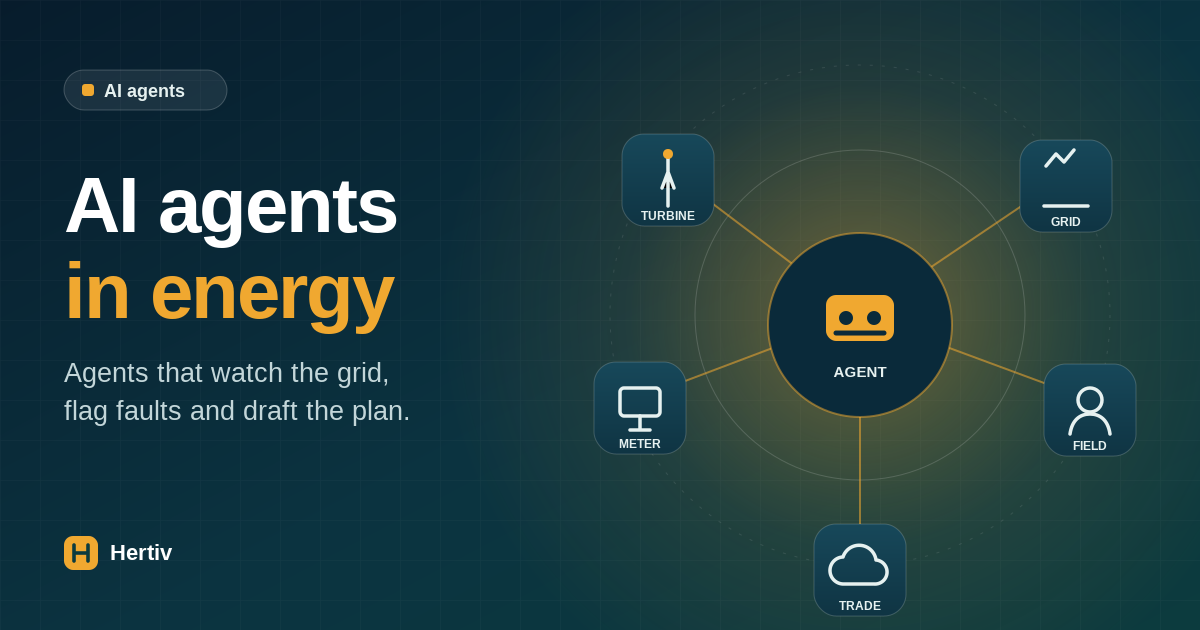
AI agents in energy monitor grids, schedule maintenance, trade power and answer customer queries. They work best on narrow tasks with a human in charge.
On this page
Short answer
AI agents in energy are software systems that carry out multi-step tasks across power grids, plants and customer operations, such as watching sensor data, flagging faults, scheduling maintenance and drafting reports. They fit where the task is repetitive, the data is already digital, and a human still approves anything that affects safety or the grid.
What are AI agents in energy?
AI agents in energy are software systems that take a goal, such as keeping a wind farm running or balancing a grid, and work through the steps to reach it: reading sensor data, checking rules, drafting a plan and handing it to a person for approval. Unlike a chatbot that answers one question, an agent chains steps together and takes actions inside other systems.
Energy is a good fit because so much of it is already measured. Turbines, substations, meters and trading desks all produce data every minute, and much of the daily work is checking that data against limits and acting when something is out of range. That is exactly the kind of repetitive, rule-based work an agent handles well.
| Area | What the agent does | Human role |
|---|---|---|
| Grid operations | Watches load and flags overloads | Approves switching decisions |
| Maintenance | Spots early fault signs | Books and checks the repair |
| Trading | Drafts bids and forecasts | Sets limits and signs off |
| Field work | Prepares job packs and parts lists | Carries out the work |
| Customers | Answers billing and outage queries | Handles disputes and complaints |
The key point is that the agent assists, it does not replace the operator. In energy, a wrong action can cut power or damage equipment, so the agent's job is to prepare, flag and draft, while the human decides.
How do AI agents help run the grid?
AI agents help run the grid by watching far more data than a person can, and by raising only the cases that need attention. A grid operator cannot watch every substation reading, so the agent filters the stream and presents the exceptions with the context needed to act.
A typical agent checks load against forecasts, watches for voltage drift, and compares current readings with the same hour last week. When something is out of range, it pulls the recent history, the maintenance schedule and the weather forecast, and drafts a short summary for the operator. The operator then decides whether to switch load or send a crew.
Agents also help with demand forecasting. By combining past usage, weather and calendar events, they draft the next day's load plan for a human to approve. The forecast is never taken as fact; it is a starting point that the operator adjusts.
For teams building this kind of system, AI and blockchain for energy and utilities covers the data and integration patterns that matter.
What do agents do in energy trading and billing?
In energy trading, agents draft bids, check them against price limits and prepare the paperwork, while traders keep the final decision. The agent can scan market data, compare it with the company's positions and flag a gap, but it does not place trades on its own.
The value is speed and coverage. A trading desk watches many contracts at once, and an agent can check every one of them against the same rules every few minutes, catching a limit breach that a person might miss at the end of a long shift.
In billing, agents read meter data, spot anomalies such as a sudden jump in usage, and draft the customer message explaining the bill. The agent does not change a bill; it prepares the case so a person can decide quickly. This is the same pattern as AI agents in logistics, where agents prepare and flag while people decide.
Settlement is another fit. Agents can match trades to invoices, flag mismatches and prepare the reconciliation report, which cuts the manual checking that used to take a team most of the morning.
How do agents help with maintenance and field work?
Agents help with maintenance by reading sensor data from turbines, transformers and pumps, and spotting the early signs of a fault before it becomes a failure. Vibration, temperature and output trends each tell part of the story, and the agent combines them into a short list of assets to check.
For field work, the agent prepares the job pack: the asset history, the likely fault, the parts needed and the safety notes for the site. A technician who used to spend an hour gathering this before a visit can start work with the pack already prepared.
After the job, the agent can draft the maintenance report from the technician's notes and the sensor readings, so the record is complete without an extra hour of paperwork. The technician reviews and corrects the draft, which keeps the record accurate.
The pattern works because the data is already there. If your turbines already stream vibration and temperature data, an agent can use it. If the data is still on paper forms, digitising it comes first.
What limits AI agents in energy?
The main limit is safety. Energy systems can hurt people and damage equipment, so no agent should take a physical action without a human in the loop. Switching, isolating and starting equipment stay with trained operators, and the agent's role is to prepare and recommend.
Regulation is the second limit. Grid operators and utilities work under rules about who can change settings, how decisions are recorded and how data is handled. An agent that cannot show its reasoning, or that acts outside its approved scope, will not pass an audit.
Data quality is the third limit. Sensors fail, readings drift and maintenance logs are incomplete. An agent trained on bad data will flag the wrong assets, so the data has to be checked before the agent is trusted.
Finally, there is the risk of over-trust. If an agent is right 95 times in a row, operators stop checking its work, and the 96th case is the one that matters. Good design keeps the human check visible: the agent shows its sources and its confidence, and the operator signs off. AI governance and responsible AI consulting covers how to set those limits.
Example: a wind farm maintenance agent
Example (hypothetical): a wind farm with 120 turbines installs an agent that reads vibration, temperature and output data from every turbine, every hour. That is 120 turbines times 24 readings, or 2,880 readings a day, far more than any engineer can watch by hand.
Each morning the agent flags the turbines that need attention. On a typical day it flags 12 out of 120. An engineer reviews each flagged turbine, which takes about 10 minutes each, so 120 minutes of review a day. Without the agent, checking every turbine by hand would take about 1 minute per reading, or 48 hours a day, which is not possible.
Over a month the agent flags about 360 turbines, and about 60 of them turn out to need a real repair. The other 300 are false alarms, which the engineer clears quickly. The farm still sends a crew to every real fault, but it finds them days earlier than before, when a turbine would have failed outright.
The saving is not the review time; it is the avoided failures. One avoided gearbox failure pays for months of running the agent, which is why the farm measures success in faults caught early, not in hours saved.
What are the common mistakes?
The most common mistakes with AI agents in energy are giving the agent too much authority, trusting it without checks, and starting with the hardest task instead of the narrowest one.
- Letting the agent act on physical systems. Switching, isolating and starting equipment must stay with trained operators. The agent prepares and recommends.
- Skipping the audit trail. Every agent action needs a log of what it read, what it decided and who approved it, or it will not pass a review.
- Starting with grid control. Begin with reporting, fault flagging or job packs, where a mistake costs time, not power.
- Trusting bad sensor data. Check sensor quality first, or the agent will flag the wrong assets and lose the team's trust.
- Measuring hours saved only. The real return in energy is avoided failures and earlier fault detection, not minutes saved.
If you are planning an agent for grid, trading or maintenance work, multi-agent systems development covers the design patterns, and the first step is usually a narrow pilot with a clear approval gate.
Key takeaways
- AI agents in energy prepare, flag and draft; humans keep the decisions that affect safety and the grid
- Grid, maintenance, trading and field work all fit, because the data is already digital and the tasks repeat
- The agent's value is coverage: watching thousands of readings and raising only the exceptions
- Safety, regulation and data quality set the limits; every agent action needs a log and a human sign-off
- Measure success in faults caught early and failures avoided, not only in hours saved
Frequently asked questions
What do AI agents do in energy?
They carry out multi-step tasks such as watching sensor data, flagging faults, drafting maintenance job packs, preparing trading bids and answering customer queries. A human still approves anything that affects safety, the grid or a customer account.
Can an AI agent control the grid?
No, not on its own. Agents can monitor load, forecast demand and draft switching plans, but switching and isolation stay with trained operators. The agent prepares the decision; the operator makes it.
How do agents help with maintenance?
They read vibration, temperature and output data from equipment, spot early signs of faults, and prepare job packs with the asset history, likely fault and parts needed, so technicians start work faster.
What data does an energy agent need?
It needs the data your equipment already produces: sensor readings, maintenance logs, meter data and trading positions. If that data is still on paper or in scattered spreadsheets, digitising it comes first.
Are AI agents safe to use in energy?
They are safe when their scope is narrow, their actions are logged, and a human approves anything physical or financial. The risk comes from giving an agent authority it should not have, or from operators trusting it without checking.
Where should an energy company start?
Start with a narrow task where a mistake costs time, not power: fault flagging, job packs or billing checks. Measure faults caught early, then expand only once the team trusts the agent's flags.


