Agentic AI in Education: 8 Use Cases That Work
Agentic AI in education works where a task has a goal, tools and a human checkpoint: admissions, tutoring, grading, timetables, aid, research and outreach.
On this page
Short answer
Agentic AI in education works best on jobs with a clear goal, a set of tools and a human checkpoint: chasing missing admission documents, planning a student's study path, marking work with explanations, or spotting students who are falling behind. The agent does the legwork; a teacher or administrator checks the result before it counts.
Which agentic AI use cases work in education?
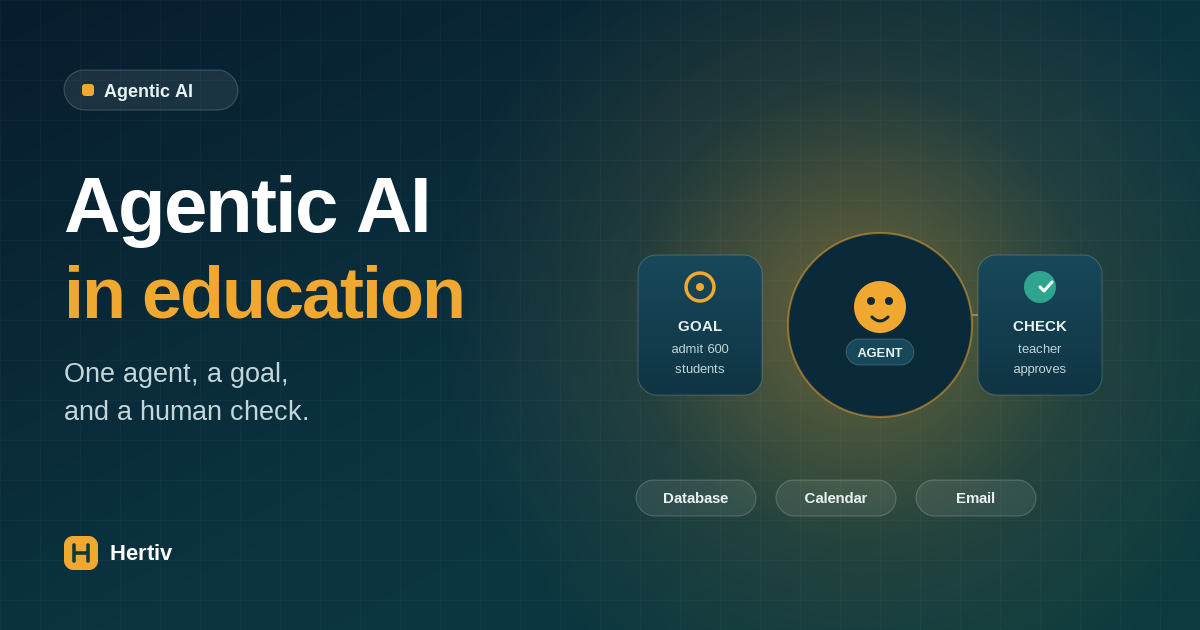
An agentic AI system is one agent that takes a goal, makes a plan, uses tools such as a database or a calendar, checks its own work and asks a human when it is unsure. That is different from a chatbot, which only answers one question at a time, and from a team of agents, which splits the job between several specialists.
The use cases below all share the same shape: a goal a teacher or administrator would set, a set of tools the agent can call, and a human checkpoint before anything reaches a student or a record. The same pattern works in other sectors, as the finance use cases show.
| Use case | What the agent does | Human checkpoint | Best for |
|---|---|---|---|
| Admissions chase | Finds missing documents, nudges applicants | Staff confirm the offer | Busy admissions teams |
| Study-path tutor | Plans practice, adapts to progress | Teacher reviews the plan | Large classes |
| Grading support | Marks, explains, flags edge cases | Teacher approves the mark | Frequent low-stakes work |
| Timetable planning | Builds draft timetables from rules | Staff approve the final grid | Schools with many rooms |
| Financial-aid guidance | Matches students to aid, drafts letters | Adviser checks eligibility | Universities with many schemes |
| Research help | Searches papers, drafts summaries | Student checks the sources | Postgraduate students |
| Early warning | Spots falling attendance and grades | Tutor decides the next step | Retention teams |
| Outreach | Drafts personal messages to parents and alumni | Staff approve before sending | Schools and alumni offices |
Admissions chase and study-path tutor: the agent that follows up
1. Admissions document chase: best for busy admissions teams
An admissions agent checks each application against the document list, finds what is missing, and sends a personal nudge to the applicant with a link to upload it. It re-checks the file each morning and moves complete applications to the review pile.
The agent never makes an offer. Staff confirm the decision, and the agent only handles the chasing that used to eat half the admissions team's week.
Pros:
- Missing documents get chased the same day, not the same month
- Staff see a clean list of complete files
- Applicants get a clear, personal message
Cons:
- Needs clean data from the application system
- Poorly written nudges can confuse applicants
2. Study-path tutor: best for large classes
A tutoring agent takes a student's goal, such as passing a maths exam in eight weeks, and builds a practice plan from the syllabus, the student's past scores and the time they have. It sets the next task, checks the answer and changes the plan when the student struggles.
The teacher reviews the plan each week and can override it. The agent handles the daily adaptation that one teacher cannot do for 200 students.
Pros:
- Every student gets a plan that adapts to their progress
- Teachers see where the whole class is stuck
- Practice runs outside lesson time
Cons:
- Needs good syllabus data to plan well
- Can drill too narrowly without teacher guidance
Grading support and timetable planning: the agent that drafts
3. Grading support: best for frequent low-stakes work
A grading agent marks short answers and quizzes against the mark scheme, writes a short explanation for each mark, and flags the answers it is unsure about for the teacher. The teacher approves the marks before they are recorded.
This works best on work that is marked often and counts little, such as weekly quizzes. High-stakes exams still need a human marker, with the agent as a second check.
Pros:
- Feedback reaches students in hours, not weeks
- Every mark comes with a written reason
- Edge cases are flagged, not guessed
Cons:
- Needs a clear mark scheme to follow
- Can be unfair on unusual but correct answers
4. Timetable planning: best for schools with many rooms
A timetabling agent takes the rules, such as room sizes, teacher availability and which classes cannot clash, and drafts a timetable that satisfies them. It tries several versions, scores them, and shows the best one to the timetable manager.
The manager still approves the final grid and handles the exceptions the agent cannot judge, such as a teacher who prefers mornings. The agent turns a week of manual juggling into a day of checking.
Pros:
- Drafts in hours what took a week by hand
- Shows which rules forced each compromise
- Easy to re-run when a rule changes
Cons:
- Needs accurate room and staffing data
- Cannot judge human preferences on its own
Financial-aid guidance and research help: the agent that gathers
5. Financial-aid guidance: best for universities with many schemes
A financial-aid agent asks a student a few questions, matches them against the aid schemes they qualify for, and drafts the application letters with the right figures from the student record. An adviser checks eligibility before anything is submitted.
Students often miss aid because they never find the scheme that fits them. The agent's job is to search the full list, not to decide who gets the money.
Pros:
- Students see every scheme they qualify for
- Letters are drafted with correct figures
- Advisers spend time on edge cases, not on search
Cons:
- Scheme rules change and must be kept current
- Wrong matches waste the adviser's time
6. Research help: best for postgraduate students
A research agent searches the library and public paper indexes for a question, reads the abstracts, groups the papers by theme and drafts a summary with links to each source. The student checks the sources before citing anything.
The agent saves the searching and sorting, not the reading. A summary is only a starting point, and the student must still read the papers that matter.
Pros:
- Finds papers across many indexes at once
- Groups results by theme with source links
- Frees time for reading the key papers
Cons:
- Summaries can miss the paper's real point
- Students must still verify every citation
Early warning and outreach: the agent that watches and writes
7. Attendance and early warning: best for retention teams
An early-warning agent watches attendance, submitted work and grades, and flags students whose pattern has changed, such as three missed sessions after a steady record. It drafts a short note for the tutor with the facts and a suggested next step.
The tutor decides what happens next. The agent only makes sure the pattern is noticed early, when a conversation can still change the outcome.
Pros:
- Patterns are spotted in days, not at the end of term
- Tutors get facts, not a vague worry
- Works across attendance, work and grades together
Cons:
- Needs clean attendance and grade data
- Can flag students who are simply ill
8. Parent and alumni outreach: best for schools and alumni offices
An outreach agent drafts personal messages to parents about progress and to alumni about events, using the facts from the student record and the alumni database. Staff approve every message before it is sent.
Personal messages take time to write, so schools send few of them. The agent drafts them at scale, and the human check keeps the tone right.
Pros:
- More families and alumni hear from the school
- Messages use real facts from the record
- Staff approve the tone before sending
Cons:
- Drafts can sound flat without a human edit
- Needs up-to-date contact details
How to choose an agentic AI use case in education
Pick a job where the goal is clear, the tools exist and a human can check the result. If any of those three is missing, the use case is not ready yet. Copilots are a simpler first step for many schools, as the education copilot use cases show.
- List the repetitive jobs your team does each week and pick the one with the clearest goal.
- Check the data: the agent needs a clean source, such as the student record or the timetable system.
- Define the human checkpoint in writing: who checks, what they check, and what happens when the agent is unsure.
- Run a small pilot with one class or one intake, and measure time saved and errors caught.
- Expand only when the pilot shows fewer errors and real time saved, not just a faster first draft.
Example (hypothetical): an admissions team handles 600 applications. Checking documents by hand takes 20 minutes per application, so 600 times 20 minutes is 12,000 minutes, or 200 hours. An agent pre-checks 420 clean files at 2 minutes each, which is 14 hours, and flags 180 files for staff at 15 minutes each, which is 45 hours. The total is 59 hours, so the team saves 141 hours and every applicant hears back sooner.
What are the common mistakes?
The most common mistake is letting the agent decide instead of draft. An agent that sends offers, records marks or contacts parents without a human check will make a mistake that matters, and the school owns the result.
Other mistakes follow the same pattern: giving the agent a vague goal such as help students, feeding it messy data and expecting clean output, and skipping the pilot. Start with one narrow job, one clean data source and one named checker.
Keep the agent's job small enough that one person can check it in a few minutes. If checking takes longer than doing the job by hand, the agent is not saving time.
Do not judge the agent by how much it writes. Judge it by how often its work is right and how quickly a human can check it. A short, correct draft beats a long one that needs a full rewrite.
Key takeaways
- Pick jobs with a clear goal, tools the agent can call, and a human checkpoint.
- The agent drafts and gathers; a teacher or administrator decides.
- Admissions chasing and grading support save the most staff time first.
- Clean data matters more than a cleverer model.
- Pilot with one class or intake before expanding.
Frequently asked questions
What is agentic AI in education?
Agentic AI is a system where one agent takes a goal, makes a plan, uses tools such as a database or calendar, checks its own work and asks a human when unsure. In education it handles jobs like chasing documents, planning study paths and flagging students who need help.
How is agentic AI different from a chatbot?
A chatbot answers one question at a time and then waits. An agentic system keeps working toward a goal across several steps, using tools and checking its own results, with a human checkpoint before anything reaches a student or a record.
Which agentic AI use case should a school try first?
Start with admissions document chasing or grading support. Both have a clear goal, clean data and a simple human check, and both save measurable staff time in the first term.
Can an agentic AI agent mark exams?
It can draft marks for low-stakes work such as weekly quizzes, with a teacher approving each mark. High-stakes exams still need a human marker, with the agent as a second check rather than the decision maker.
What data does an education agent need?
It needs clean data from systems the school already runs, such as the student record, the timetable and the attendance register. Messy or out-of-date data produces wrong drafts, so fixing the data comes before buying the agent.
What goes wrong with agentic AI in schools?
The usual failures are a vague goal, messy data and no human checkpoint. An agent left to decide on its own will eventually send the wrong message or record the wrong mark, so every output needs a named person who checks it.


