Agentic AI in Finance: Where It Works and What to Watch
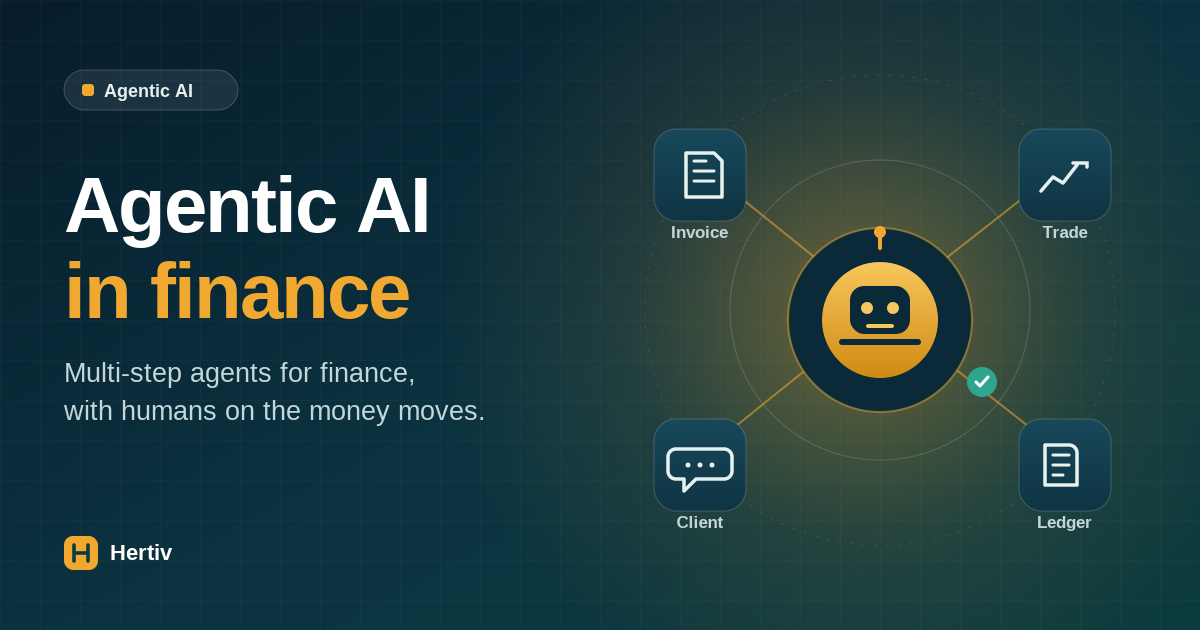
Agentic AI in finance runs multi-step jobs like chasing invoices, checking trades and answering client questions, with a person approving anything that moves money.
On this page
Short answer
Agentic AI in finance is software that carries out multi-step financial tasks on its own, such as reconciling accounts, chasing overdue invoices, checking trades against limits and drafting client replies. It works through high-volume routine work, and hands anything uncertain, or anything that moves money, to a person for approval.
What is agentic AI in finance?
Agentic AI in finance is software that carries out multi-step financial tasks on its own, such as reconciling accounts, chasing overdue invoices, checking trades against limits and drafting client replies, and hands anything uncertain to a person. Unlike a chatbot that only answers one question at a time, an agent plans a sequence of steps, uses your systems to carry them out, and stops when it reaches a limit it cannot clear alone.
A finance agent is not a replacement for the finance team. It is a worker that handles the routine steps of a job, gathering data, checking it against rules and drafting the next action, while people keep the decisions that carry real risk. The agent's value is that it works through volume: hundreds of invoices, trades or client messages that would take a person days to clear.
Three traits separate a finance agent from a simple script:
- It reads live data from your systems, not a fixed file.
- It follows a plan with branches and changes course when a check fails.
- It asks a person to approve anything that moves money or changes a record.
Where does agentic AI help in finance?
Agentic AI helps most where finance work is high-volume, rule-based and spread across systems. The table below shows the jobs where agents are already in use, and the human check that stays in place for each one.
| Job | What the agent does | Human check |
|---|---|---|
| Invoice chasing | Drafts reminders, matches payments, updates the ledger | Staff approve write-offs and payment plans |
| Trade checks | Checks trades against limits and flags breaches | Traders approve exceptions |
| Client questions | Drafts answers from account data and policy docs | Staff review replies about money movements |
| Reconciliation | Matches bank lines to ledger entries | Accountants clear unmatched items |
| Compliance screening | Screens transactions against watchlists | Officers decide on flagged cases |
| Reporting | Gathers figures and drafts monthly packs | Finance lead signs off before release |
The pattern is the same in each row: the agent does the gathering and drafting, and a person makes the call that carries risk. Jobs that need judgement about a client relationship or a new type of deal stay with people, because the agent has no context for them.
The same pattern works in other industries: AI agents in logistics handle dispatch delays and tracking in the same way, with people deciding the exceptions.
How does an agentic finance workflow run?
An agentic finance workflow runs as a loop: the agent reads the task, gathers data, checks it against rules, acts within its limits, and logs every step so a person can review it later.
- Take in the task. A trigger starts the job: a new invoice, a trade, a client message or a scheduled run.
- Gather the data. The agent pulls records from the ledger, bank feed, CRM or trading system.
- Check the rules. It compares the data with limits, policies and past cases.
- Act inside its limits. It drafts, files or sends what is allowed, and stops at anything it cannot clear.
- Hand off and log. Uncertain cases go to a person with the evidence attached, and every step is recorded.
The design questions are the same as in any agentic project: scoped tools, approval gates and full traces. Agentic AI development covers those patterns in more depth, including how to keep an agent from reaching systems it should not touch.
What controls keep agentic AI safe in finance?
Finance is the wrong place for an agent with open-ended access. The controls that matter are approval gates for money movements, hard limits on amounts, read-only access where writing is not needed, and a complete log of every action.
- Approval gates. No payment, transfer or write-off moves without a person signing it off.
- Amount limits. The agent can act alone only below a set value; anything above goes to a person.
- Scoped access. The agent sees only the accounts and systems its job needs.
- Full logs. Every prompt, tool call and decision is recorded for audit.
- Kill switch. One action stops the agent and freezes its pending work.
These controls are part of the build, not an add-on. Teams that plan AI agents for finance teams usually set the limits and gates before the first workflow goes live, and test them with cases designed to fail.
Example (hypothetical): an invoice-chasing agent
Example (hypothetical): a finance team has 200 overdue invoices, each worth $500 on average, so $100,000 is outstanding. The agent drafts a reminder for each invoice and matches incoming payments to the ledger as they arrive.
Within two weeks, 120 customers pay, which brings in $60,000. Staff spend 10 hours reviewing the 80 invoices that are still unpaid, instead of 40 hours drafting reminders by hand. The agent did not decide anything about write-offs or payment plans: those cases went to staff with the payment history attached.
The saving is not just time. Every reminder went out on the same day, with the same wording and the right balance, which is hard for a busy team to do by hand across 200 accounts.
What are the common mistakes?
The most common mistakes in finance agents come from giving the agent too much freedom too soon, and from treating the log as optional.
- Giving the agent write access to bank accounts before the approval gates exist.
- Letting the agent act on stale data, such as an old price list or an outdated limit.
- No fallback. When a system is down, the agent keeps retrying instead of stopping.
- Skipping the log review, so nobody notices the agent drifting from its rules.
- Starting with the riskiest job, such as payments, instead of a read-only job like reporting.
How to start with agentic AI in finance
Start with one narrow job that is high-volume and low-risk, prove the controls work, and only then widen the agent's remit.
- Pick one job, such as invoice chasing or reconciliation, with a clear owner.
- Map the data the agent needs and the systems it must read.
- Set the limits: what it can do alone, what needs approval, and the amount cap.
- Run it in shadow mode first, comparing its drafts with what staff would have done.
- Go live with review, then widen the remit only after a month of clean logs.
If your organisation has no AI governance in place yet, AI governance and responsible AI consulting is worth doing before agents get write access to financial systems.
Key takeaways
- Agents do the gathering and drafting; people make the calls that carry risk
- Approval gates and amount limits are the core controls, not an afterthought
- Start with one high-volume, low-risk job and run it in shadow mode first
- Every step must be logged so a person can review and audit it
- The value is volume: hundreds of routine cases cleared the same way, every time
Frequently asked questions
What is the difference between an AI agent and a chatbot in finance?
A chatbot answers one question at a time from a fixed script or knowledge base. An agent plans a sequence of steps, pulls live data from your systems, acts within set limits and hands uncertain cases to a person. The agent does work; the chatbot only talks.
Can an agentic AI move money on its own?
It should not. A well-designed finance agent drafts payments and transfers, then waits for a person to approve them. Amount limits decide what the agent can do alone, and anything above the limit, or anything unusual, goes to a person first.
Which finance jobs suit agentic AI best?
High-volume, rule-based jobs suit it best: invoice chasing, reconciliation, trade checks, compliance screening and routine client questions. Jobs that need judgement about a relationship or a new type of deal stay with people.
What data does a finance agent need?
It needs read access to the ledger, bank feeds, CRM and the systems that hold the records for its job. It should see only what that job needs, and every read should be logged so the team can audit what the agent looked at.
How do you measure whether a finance agent works?
Track the share of cases completed without a person, the time staff save, the error rate against a fixed sample, and how often the agent escalates. Review the logs weekly at first, so drift from the rules is caught early.
What happens if the agent makes a mistake?
The log shows exactly what the agent did and why, which makes the mistake easy to trace. The kill switch stops further work, the affected cases go to a person, and the rule or limit that failed gets fixed before the agent runs again.


