Agentic AI in Customer Service: What It Does and When It Fits
Agentic AI in customer service finishes multi-step requests on its own: it checks the order, applies the policy, issues the refund and hands hard cases to a person.
On this page
Short answer
Agentic AI in customer service is software that resolves a customer request end to end instead of answering one question at a time. It reads the request, checks the order and the policy, takes the action inside your systems, and confirms the result to the customer, handing off to a person when the case needs judgement or falls outside its rules.
What is agentic AI in customer service?
Agentic AI in customer service is software that takes a customer request and works through the steps to resolve it, rather than answering a single question and stopping. A customer writes "my delivery is late and I want a refund", and the agent checks the order, checks the delivery status, checks the refund policy, issues the refund and tells the customer what happened.
The difference from a chatbot is the follow-through. A chatbot answers questions; an agentic system takes actions. It connects to your order system, your CRM and your payment tool, and it uses them the way a trained agent would, within limits you set in advance.
| Request | What the agent does | Human role |
|---|---|---|
| Order status | Looks up the order and explains the delay | None, unless the customer disputes it |
| Refund | Checks the policy and issues it if it fits | Approves refunds above the set limit |
| Change an appointment | Finds a free slot and moves the booking | Handles clashes the agent cannot resolve |
| Complaint | Reads the history and drafts a reply | Reviews and sends the reply |
| Product question | Answers from the help centre with sources | Answers when the sources conflict |
Agentic AI fits best where the request follows a rule and the data is already in your systems. If the answer needs a judgement call, the agent's job is to prepare the case and hand it to a person, not to guess.
How is an agentic AI different from a chatbot?
An agentic AI is different from a chatbot in that it finishes tasks, while a chatbot answers questions. A chatbot tells the customer where their parcel is. An agentic system checks the parcel, finds it is lost, checks the refund policy, issues the refund and sends the confirmation, all in one conversation.
The second difference is tools. A chatbot usually has one source of knowledge, the help centre. An agentic system has several tools: the order system, the CRM, the payment tool and the booking system, and it chooses which one to use at each step. That is what lets it act instead of only replying.
The third difference is memory across steps. A chatbot treats each message on its own. An agent keeps track of what it has already checked, so it does not ask the customer for the order number twice or repeat a step it already finished.
For a full comparison of the two, see AI agent vs chatbot. The short version is that a chatbot is a question-and-answer tool, while an agentic system is a worker that follows a process to a result.
What tasks fit agentic AI in customer service?
The tasks that fit agentic AI are the ones with a clear rule, a clear data source and a reversible outcome. Order status, delivery tracking, password resets, appointment changes, address updates and refunds inside the policy all fit, because the agent can check the facts and act within a limit you set.
Triage is another strong fit. When a customer writes in, the agent reads the message, checks the account history and routes the case to the right team with a short summary. That saves the team the first five minutes of reading and sorting, and it gets urgent cases to the right person faster.
Refunds and replacements fit when the policy is written down. If the rule is "refund in full within 30 days of delivery", the agent can apply it without asking. If the rule needs interpretation, such as a damaged item where the photos are unclear, the agent should prepare the case and hand it over.
Complaints, legal questions and anything involving money above a set limit do not fit. A complaint about a service failure needs a person who can apologise and offer something the agent cannot. Set the limit in advance, for example refunds under a fixed amount, and route everything above it to a human.
How does an agentic AI resolve a request?
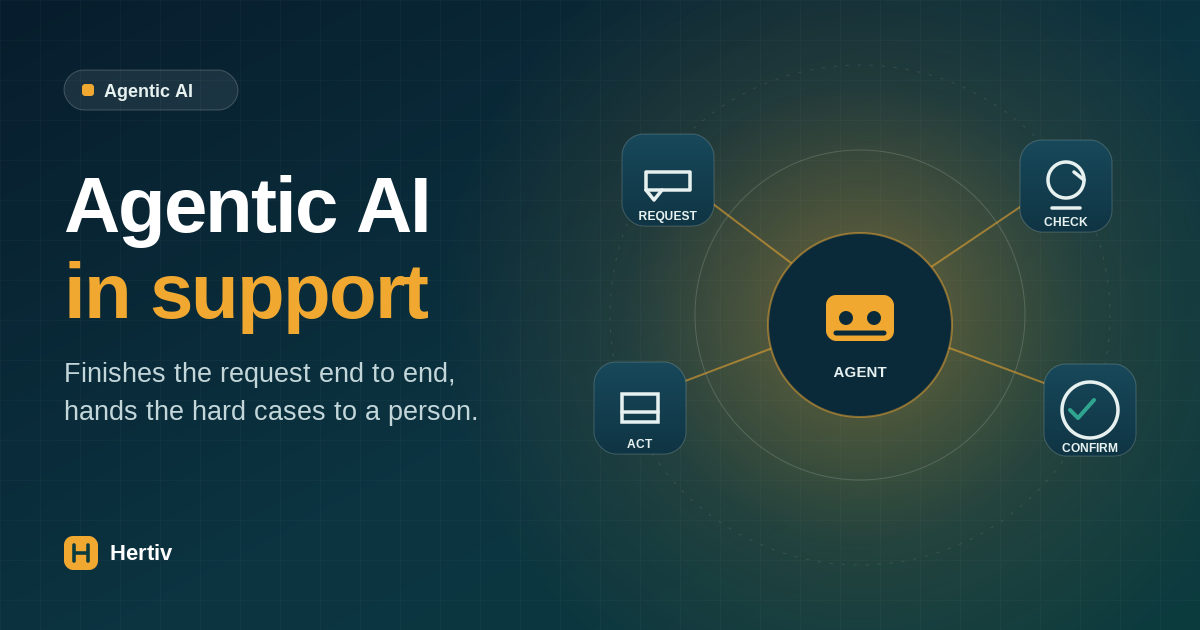
An agentic AI resolves a request by working through a short loop: understand, check, act, confirm. Each step uses a tool or a rule you defined, and the agent stops and hands off whenever a step fails or falls outside its limits.
- Understand the request. The agent reads the message and works out what the customer wants, such as a refund, a new delivery date or an address change.
- Check the facts. It looks up the order, the account and the relevant policy, so it acts on real data rather than guessing.
- Decide what is allowed. It compares the case with the rules you set: refund limits, time windows, and which actions need a human.
- Take the action. It issues the refund, moves the booking or updates the address inside your systems.
- Confirm and log. It tells the customer what happened and writes a full log of every step, so a person can check it later.
The log matters more than the speed. Every action the agent takes should be traceable: what it read, what it decided and who approved the limits it worked within. Without that, a wrong refund is hard to explain and harder to fix.
Example: a returns agent in a retail shop
Example (hypothetical): an online shop receives 2,000 return requests a month. A person takes about 20 minutes per request: finding the order, checking the return window, issuing the refund and writing back to the customer.
The shop adds an agentic system that handles the straightforward cases. It checks the order date, confirms the item is within the 30-day window, issues the refund and sends the confirmation. It resolves 1,200 of the 2,000 requests on its own. The other 800 go to a person, because the item is damaged, the window has passed or the customer disputes the amount.
For each of the 1,200 cases the agent handles, a person now spends about 2 minutes reviewing the log instead of 20 minutes doing the work. That saves 18 minutes per case. Across 1,200 cases that is 21,600 minutes, or 360 hours a month, returned to the team for the cases that need a person.
The shop measures success by the number of returns resolved correctly on the first try, not by the number the agent touched. If the agent issues a wrong refund, the saving disappears, so the team reviews a sample of the agent's work every week and tightens the rules when a mistake appears.
What guardrails does agentic AI need?
Agentic AI needs guardrails that limit what it can do without a person, because it acts inside your real systems. The most important is a spending limit: the agent can issue refunds and credits only up to a fixed amount, and anything above that waits for a human. The limit should be low at launch and raised only after the agent proves itself.
Access limits come next. The agent should reach only the systems and fields its job needs: the order system and the payment tool for refunds, but not the payroll system or the full customer database. Narrow access limits the damage if the agent makes a mistake or if its instructions are misused.
An approval gate is needed for irreversible actions. Cancelling an account, closing a case or issuing a large credit should require a person to confirm. The agent can prepare the action and explain why it is right, but it should not take it alone.
Finally, there must be a kill switch and a full log. If the agent starts behaving badly, someone should be able to stop it in one step, and the log should show every action it took so the team can undo what needs undoing. AI agents for customer support covers how to set these limits up before launch.
What are the common mistakes?
The most common mistakes with agentic AI in customer service are giving it too much authority, skipping the log, and measuring the wrong thing. All three turn a useful tool into a risk.
- Letting the agent act without limits. Refunds, credits and cancellations need a cap. Start low and raise it only after weeks of clean results.
- No audit trail. Every action needs a log of what the agent read, decided and did. Without it you cannot explain a mistake to a customer.
- Starting with complaints. Begin with order status and refunds inside the policy, where a mistake costs little, not with angry customers who need a person.
- Measuring contacts handled only. Count resolutions that were right the first time, and the cost of the mistakes, not just the volume the agent touched.
- Forgetting the handoff. When the agent cannot resolve a case, it must pass the full history to the person, so the customer does not repeat everything.
If you are planning an agent for support work, AI agent development covers the design, and the first step is usually a narrow pilot on one request type with a low refund limit.
Key takeaways
- Agentic AI in customer service finishes multi-step requests, while a chatbot only answers questions
- It fits requests with a clear rule, a clear data source and a reversible outcome
- The agent works in a loop: understand, check the facts, decide what is allowed, act, then confirm and log
- Guardrails matter most: a spending limit, narrow access, approval for irreversible actions and a kill switch
- Measure first-time resolutions that were right, not just the volume the agent touched
Frequently asked questions
What does agentic AI do in customer service?
It resolves a customer request end to end: it reads the message, checks the order and the policy, takes the action inside your systems, and confirms the result. A chatbot answers questions; an agentic system finishes the task.
How is agentic AI different from a chatbot?
A chatbot answers one question at a time from a knowledge base. An agentic system uses tools such as the order system and payment tool, keeps track of steps already done, and takes actions such as issuing a refund or moving a booking.
Which customer service tasks suit agentic AI?
Order status, delivery tracking, refunds inside the policy, appointment changes and address updates suit it well, because the rule is written down and the data is in your systems. Complaints and legal questions need a person.
Can agentic AI issue refunds on its own?
Yes, within a limit you set. A common setup lets the agent issue refunds under a fixed amount and routes anything above that to a person. Start with a low limit and raise it only after weeks of clean results.
What happens when the agent cannot resolve a case?
It should hand the case to a person with the full history attached: what the customer asked, what the agent checked and where it stopped. The customer should not have to repeat anything.
How do you know if an agentic system is working?
Check the share of cases resolved correctly on the first try, and review a random sample of its work every week. Volume alone hides mistakes, so count the cost of the wrong actions too.


